Baba Budan Archives · Original Petition · Succession and Hakdar Claims
1901–1902 – The Succession Petition of Syed Jamal Shah Khadri and Syed Khader Basha Khadri
BD-PET-1901/02-01
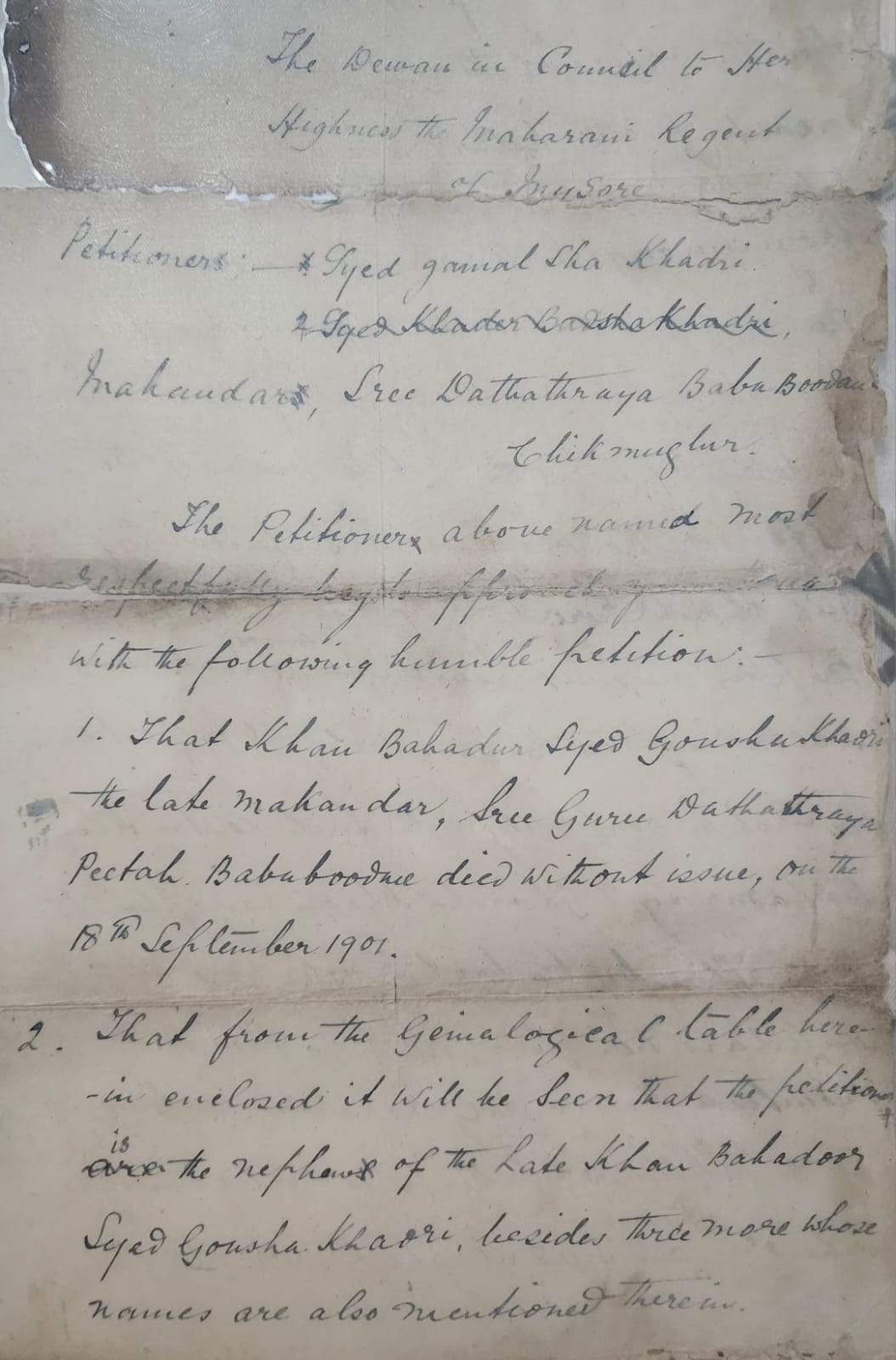
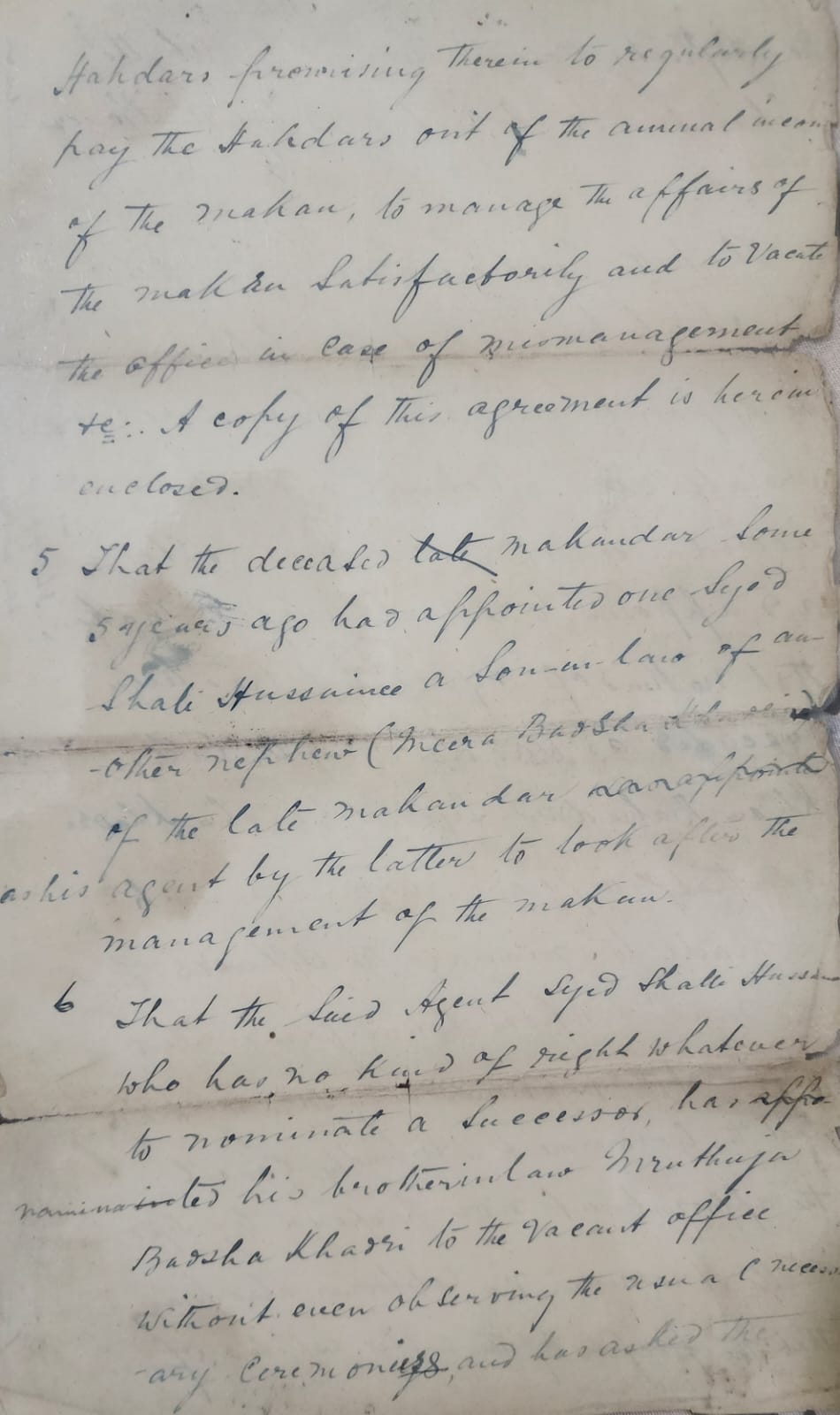
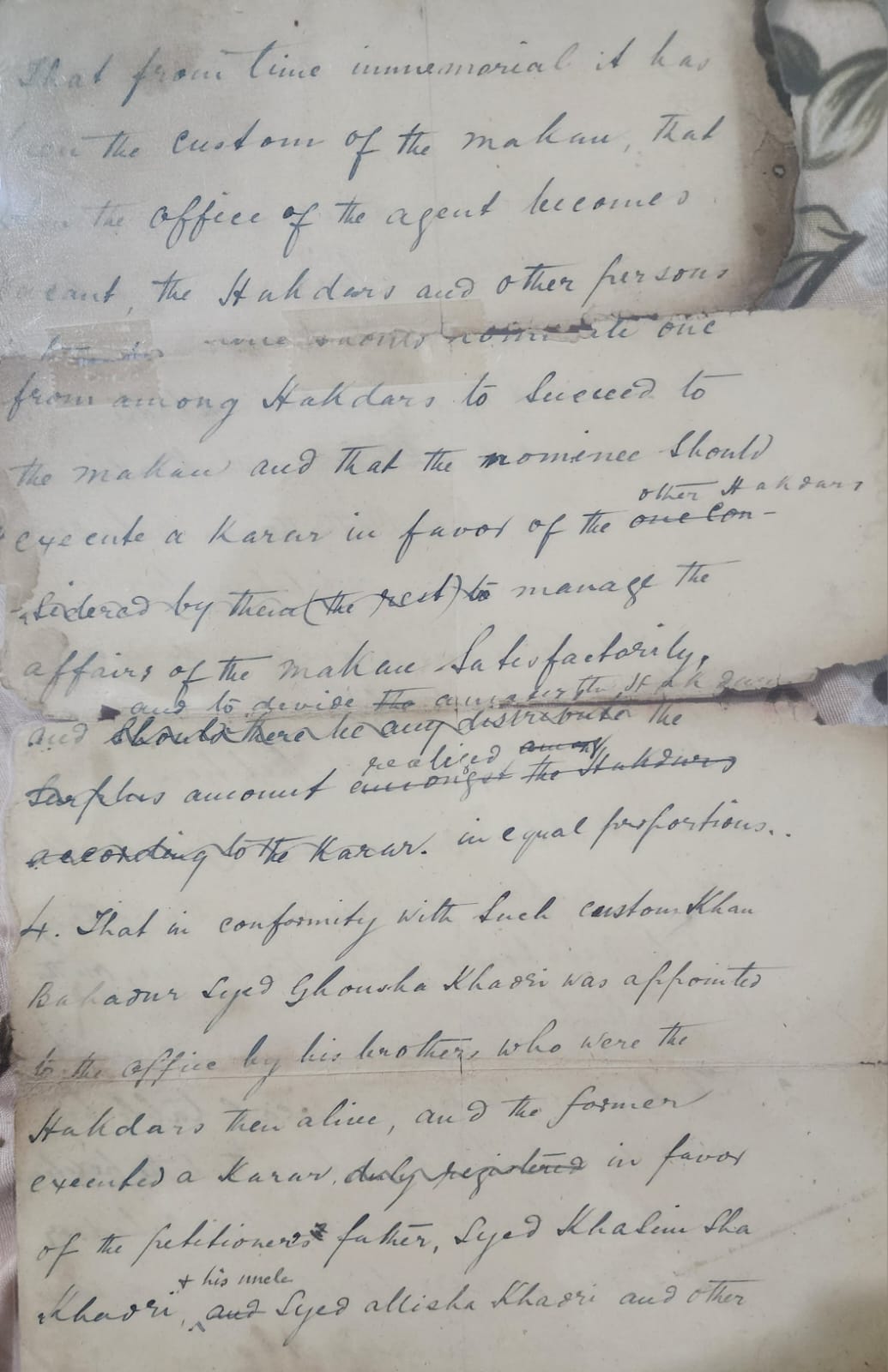
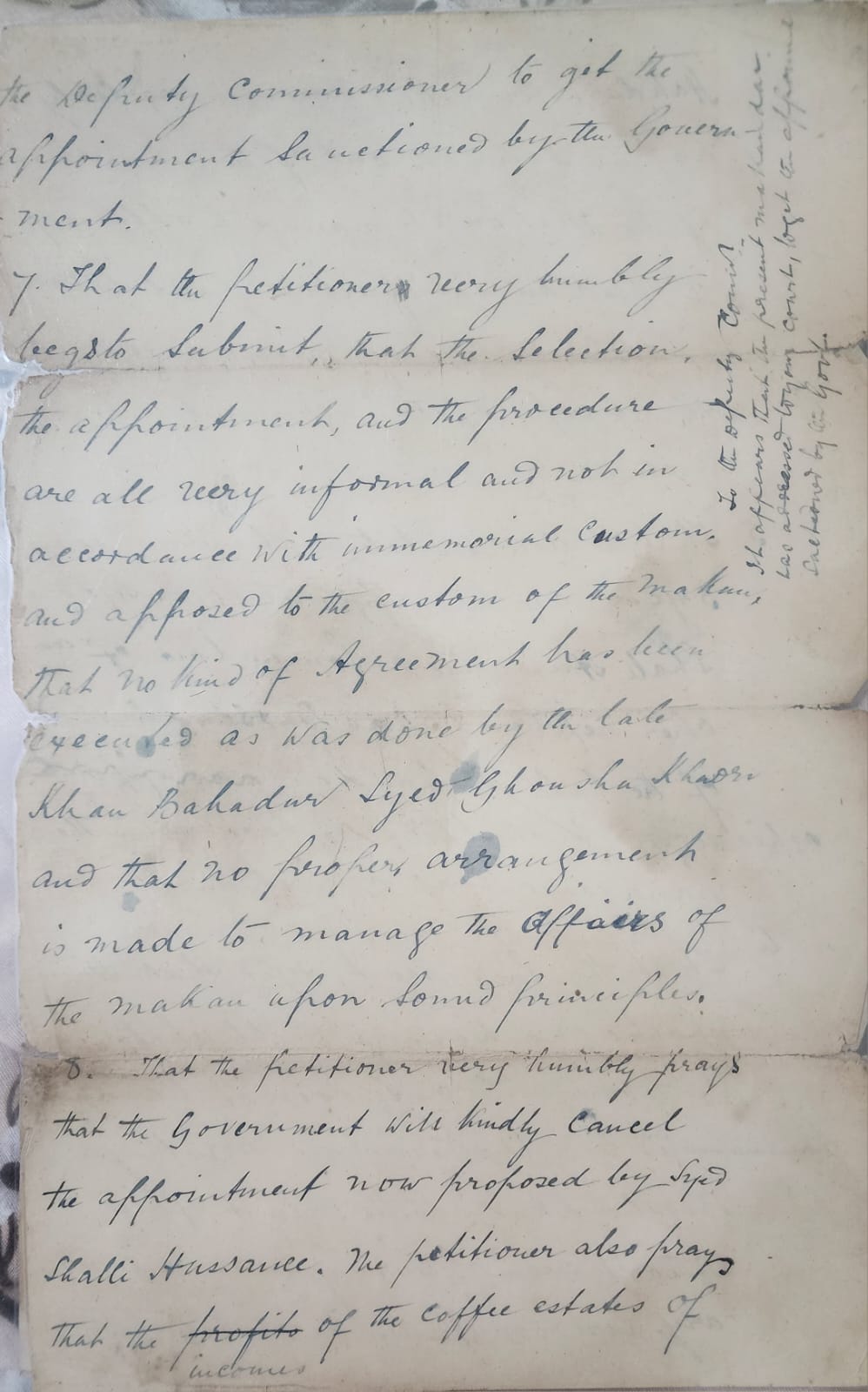
A surviving handwritten petition to the Dewan in Council of the Maharani Regent of Mysore, contesting a proposed appointment to the management of the Baba Budan Makan after the death of Syed Ghouse Shah Khadri. This entry reproduces four photographs of the petition itself and distinguishes the petitioners’ assertions from established government findings.
What these surviving pages establish
Four petition photographs supplied from a privately held historical document.
The petition itself identifies Syed Jamal Shah Khadri and Syed Khader Basha Khadri as the petitioners and concerns the succession to the Makandar’s office at the institution described as “Sree Dattathraya Baba Boodan” at Chikmagalur (spelling as written or approximately read from the manuscript).
The manuscript’s first numbered paragraph gives 18 September 1901 as the death date of Khan Bahadur Syed Ghouse Shah Khadri. Subsequent numbered paragraphs describe a claimed Hakdar selection custom, agreements called Karars, a contested nomination, and a request for government intervention.
Source-critical distinction
These are authentic photographs of a handwritten petition provided by the document holder, but this entry does not independently authenticate its provenance, handwriting, signature or date. Its statements are evidence of what the petitioners argued—not proof that the claimed succession custom, kinship, land interests or entitlement to income was legally upheld.
The petition, paragraph by paragraph
Careful summaries of the visible manuscript; uncertain readings are identified.
Manuscript section 01
Address and opening
The petition is addressed to the Dewan in Council of Her Highness the Maharani Regent of Mysore. The named petitioners are Syed Jamal Shah Khadri and Syed Khader Basha Khadri. Paragraph 1 states that Khan Bahadur Syed Ghouse Shah Khadri, described as the late Makandar, died without issue on 18 September 1901. Paragraph 2 points to an enclosed genealogical table and identifies the petitioners as nephews of the deceased.
Manuscript section 02
Custom, Hakdars and Karar
Paragraph 3 invokes an asserted longstanding custom: the agent’s office became vacant, the Hakdars and other persons entitled to participate selected a successor, and a Karar (agreement) would govern management of the Makan and division of income. The handwriting has cancellations and insertions; the exact extent and terms of the asserted custom should be checked against the enclosed Karar and other records.
Manuscript section 03
Earlier appointment and agreement
Paragraph 4 claims that Syed Ghouse Shah Khadri had been appointed by his brothers, described as Hakdars then alive, and that an agreement was executed in favour of the petitioners’ father, Syed Khalim Shah Khadri, his uncle Syed Alisha Khadri, and other Hakdars. The petition says a copy of the agreement was enclosed. The agreement itself is not among these four photographs.
Manuscript section 04
Earlier nomination and disputed recognition
Paragraph 5 refers to an earlier nomination by the deceased Makandar in favour of a nephew whose name appears in the manuscript as Syed Shali Hussainee (reading provisional). Paragraph 6 says that this agent, asserted to lack a right to nominate a successor, appointed his brother-in-law Murthuza Basha Khadri to the vacant office without observing customary ceremonies and sought the Deputy Commissioner’s approval. These are the petitioners’ characterisations.
Manuscript section 05
The relief requested
Paragraph 7 objects to the manner of selection, appointment and procedure, describing them as informal and contrary to immemorial custom. Paragraph 8 expressly asks the Government to cancel the appointment proposed by Syed Shali Hussainee. The final visible lines also raise the profits of the coffee estates. The remainder of that request is not shown in these four images, so the petition’s complete prayer cannot yet be reconstructed.
Editorial note
Corrections in the handwriting
Several words are struck through, overwritten or inserted between lines. These revisions are visible evidence of drafting and must not be silently normalised into a purported verbatim transcript. Some proper names and marginal annotations remain difficult to read.
Four photographed leaves of the original petition
Reproduced as supplied, preserving manuscript corrections, paper folds and marginalia. Click or open each image to inspect at larger size.
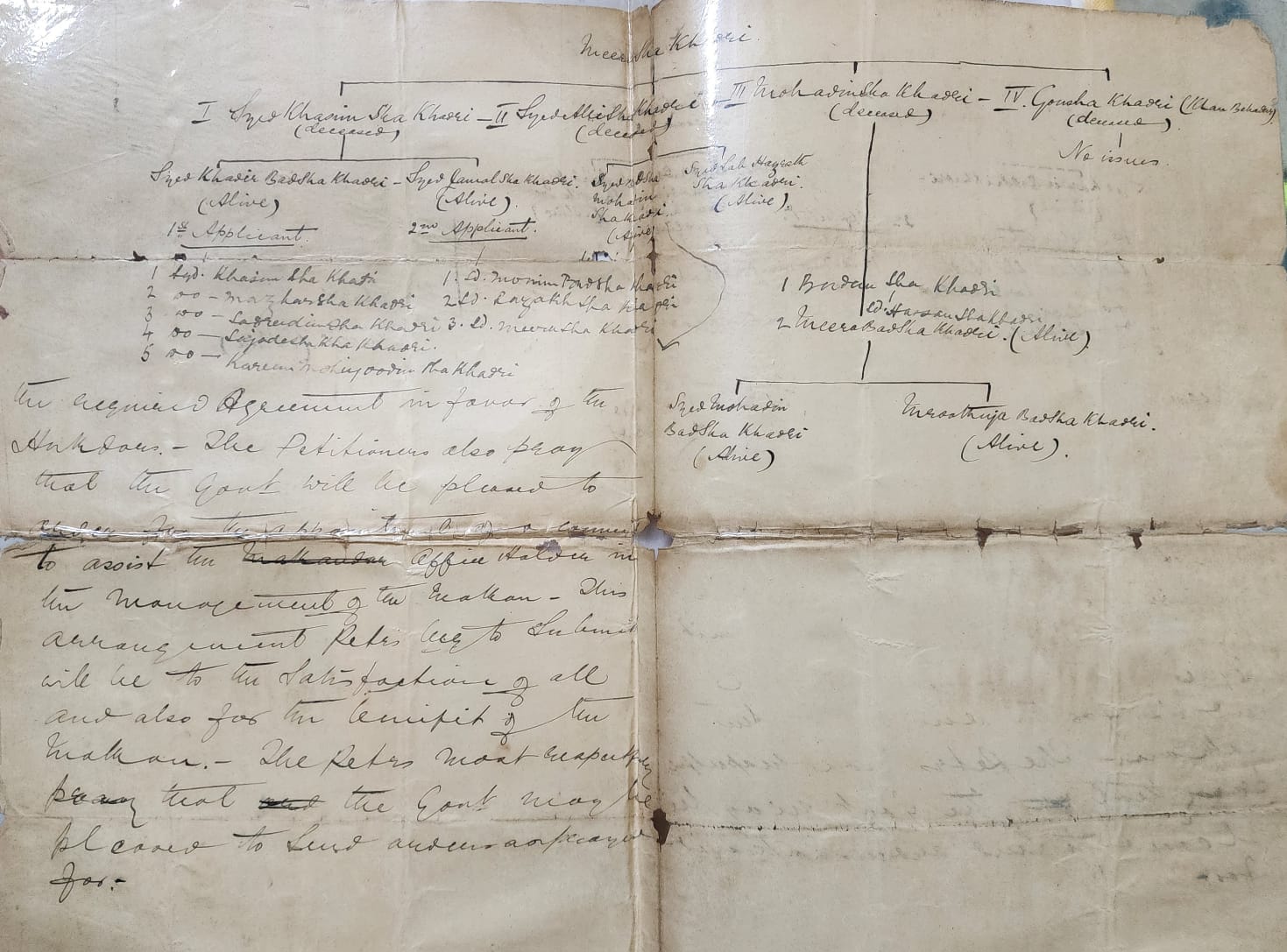
Genealogical Table and Continuation of the Petition
One photograph of a folded manuscript sheet, with the family diagram above and additional handwritten petition text below.
The upper portion depicts four numbered branches under a common ancestor. The writer marks several people as deceased or alive, and identifies persons described as the first applicant and second applicant. The right-hand branches include the names Murthuza Basha Khadri and other family members. Because folds, faded ink and historic spellings obscure some labels, this archive does not treat every handwritten name or relationship as conclusively transcribed.
Below the diagram, the manuscript continues the petitioners’ request concerning the management of the Makan. The passage asks for arrangements relating to the management and references the satisfaction of those concerned and the benefit of the Makan. These words are summarized rather than presented as an exact quotation, because portions of the handwriting and corrections are difficult to read.
Editorial distinction: This is genealogical evidence submitted in connection with a contested appointment. The diagram records the petitioners’ representation of family relationships; it does not by itself establish a legal entitlement to the office, Hakdar income, or the validity of any proposed appointment. The petition identifies Syed Shahali Hussaini as the agent involved in the contested proposal.
Names and terminology
The institution is described here as the Makan (not “Makan”). The agent’s name is Syed Shahali Hussaini. Other names in the genealogy should be checked against the original before publication of a fully transcribed or redrawn family tree.
Petition and subsequent administrative decision
Date of Syed Ghouse Shah Khadri’s death as asserted in paragraph 1 of the petition.
The two petitioners contest the proposed appointment, invoke Hakdar customs and request cancellation. The exact date on the photographed leaves is not visible.
Separate Mysore Muzrai Proceedings No. 1159 later recognised Syed Murthuza Basha Khadri. That decision is a distinct government record and should be studied on its own archive page, BD-SAJ-1902-01.
Limits of the surviving photographed material
The newly supplied genealogical enclosure shows a family diagram and additional petition text. The photographed material still does not establish the full signatures, the complete Karar, a securely identified docket date or the government’s response. A marginal note on the fourth leaf is not fully legible. No conclusion about present-day ownership, succession rights or the ultimate disposition of the coffee estates follows from this petition alone.
Source and editorial method
Principal source: four photographs of a handwritten petition and one genealogical enclosure supplied directly by the holder of the original historical papers, reproduced above. Internal references include the Dewan in Council, the Maharani Regent of Mysore, the late Makandar Syed Ghouse Shah Khadri, the Hakdars, Karars and a proposed appointment of Syed Murthuza Basha Khadri and the involvement of Syed Shahali Hussaini.
Method: This page provides an interpretive reading, not a certified diplomatic transcription. Historic spelling variants are retained where meaningful; uncertain personal-name readings are flagged. The petitioners’ allegations are attributed to them. The agent named in the dispute is Syed Shahali Hussaini (corrected identification supplied by the document holder). Related Muzrai File No. 101 (1902–03) and Proceedings No. 1159 (24 November 1902) offer context but are separate documents and should not be mistaken for pages of this petition.
Baba Budan Archives · BD-PET-1901/02-01
A petition is evidence of a claim—not the final decision
This historical record is published for archival study, with the original handwriting visible for independent examination. Additional leaves or enclosures may refine the reading.