ANEGONDI ERA
c. 14th–16th Century
THE EARLIER INAM TRADITION
The Anegondi Chiefs and the Earlier Inams
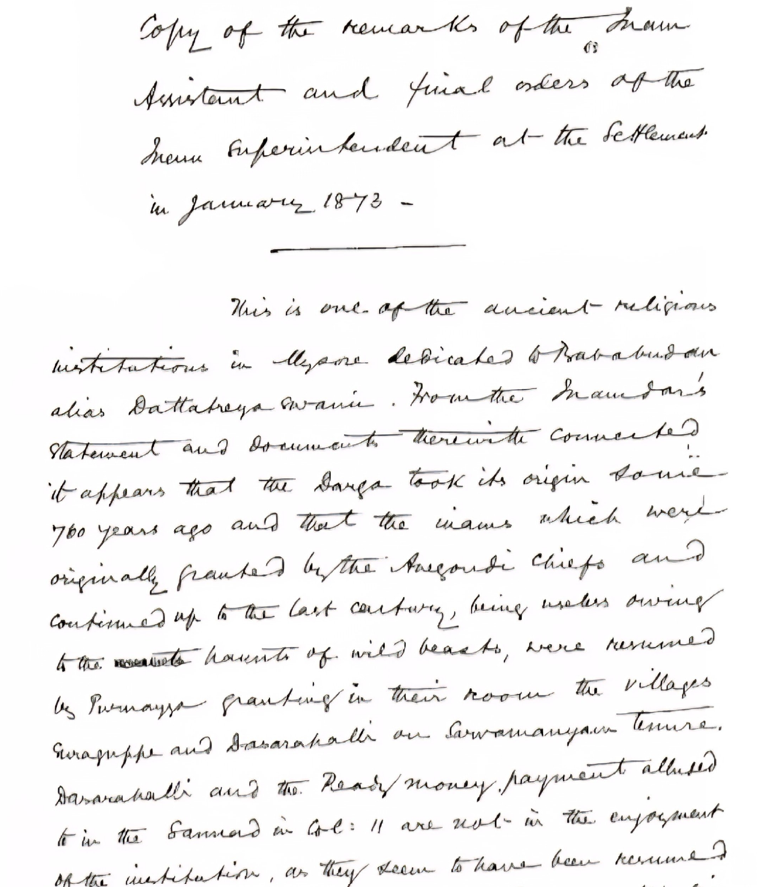
The surviving documentary record preserves an account of an earlier history of the institution’s Inams. In January 1873, the Mysore Inam Settlement authorities recorded, from the Inamdar’s statement and connected documents then before them, that the Inams had been “originally granted by the Anegondi chiefs.”
The original Anegondi grant has not yet been located in the present archive. The 1873 record therefore preserves an official nineteenth-century account of this earlier Inam tradition rather than the original grant itself.
Earlier Inam tradition · Recorded 9 January 1873 · Mysore Inam Settlement
c. 16th-17th CENTURY
THE JOURNEY OF COFFEE
Baba Budan and the Seven Seeds Tradition
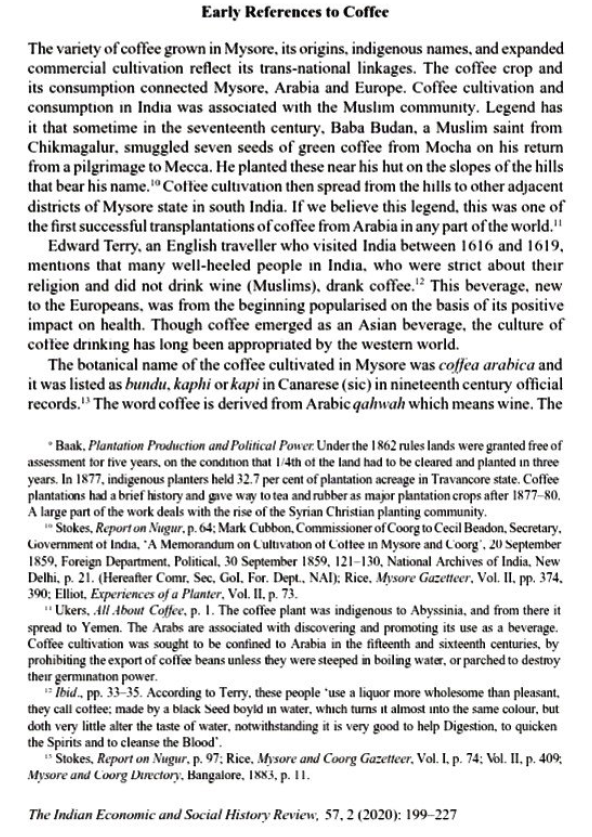
According to a long-standing tradition, Syed Budan Shah Khadri popularly known as Baba Budan returned from pilgrimage through Arabia carrying viable coffee seeds from Mocha and planted them in the hills of present-day Chikkamagaluru. Later historical sources associated these hills—eventually known as the Baba Budan Hills—with the beginnings of coffee cultivation in southern India.
The celebrated tradition remembers seven seeds of Mocha coffee. While the precise date and circumstances are not established by a surviving contemporary seventeenth-century record presently known to this archive, the association between Baba Budan, these hills and the early cultivation of coffee was already recorded in nineteenth-century reference works and remains part of India’s official coffee history
Source
Shrivastava, Sharmila. “Slopes of Struggle: Coffee on Baba Budan Hills.” The Indian Economic & Social History Review, Vol. 57, No. 2 (2020), pp. 199–227
Historical source also shown
The Imperial Gazetteer of India, Vol. X, 2nd ed. (1886), p. 101 — recording the tradition that coffee was introduced into Mysore by Baba Budan.
🟡 HISTORICAL TRADITION · DOCUMENTED IN LATER HISTORICAL & SCHOLARLY SOURCES
1798
THE EARLIEST DOCUMENT IN THE ARCHIVE
BD-SANAD-1798-01
Tipu Sultan–Era Order Concerning Baba Budan Darga Management
This Persian document preserves an order issued during the reign of Tipu Sultan to Syed Meeran Shah Khadri and forms the earliest documentary item presently featured in this archive. The surviving material includes a Persian copy together with an English translation bearing court certification.
24 July 1798 · Persian · Certified English Translation Available
🟢 PRIMARY DOCUMENT · PERSIAN COPY · COURT-CERTIFIED ENGLISH TRANSLATION
1817
AN EARLY INAM-ERA PERSIAN DOCUMENT
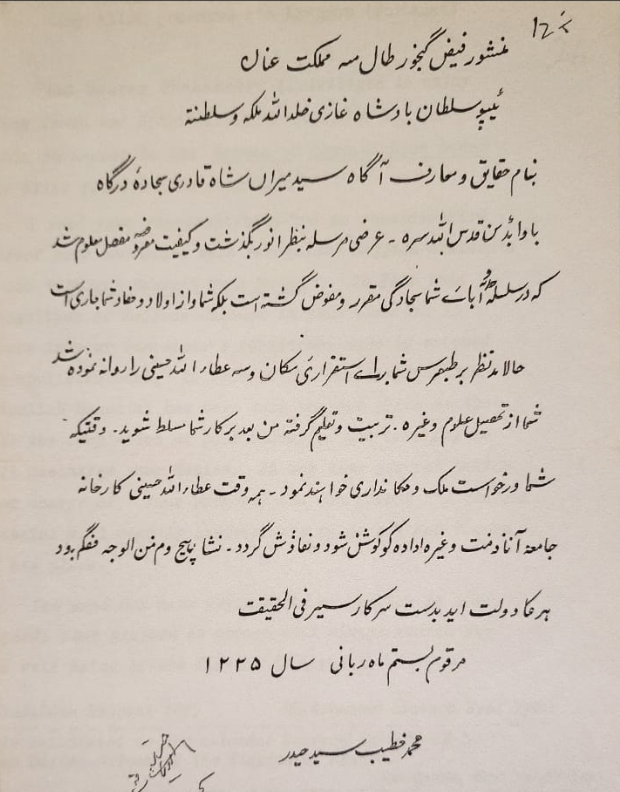
BD-SUR-1817-01
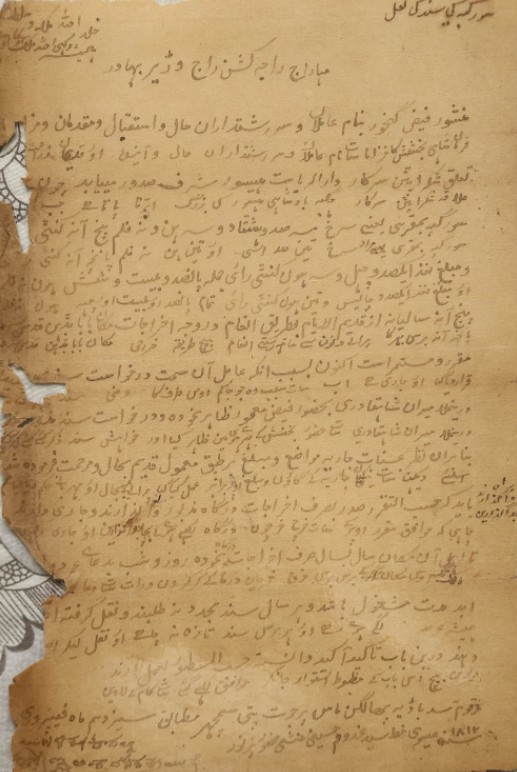
An Early Persian Record of the Baba Budan Inam Land
Addressed to Maharaja Krishnaraja Wodeyar Bahadur by Munshi Syed Maqdoom Hussaini dated 13 February 1817, this Persian document depicts a coffee-related summary of the Suraguppa lands connected with the Inam of Makan-e Baba Budan Darga under the management of Syed Meeran Shah Qadri, the Sajjada Nashin at the time.
13 February 1817 · Persian · Antique Manuscript
🟢 PRIMARY DOCUMENT · ORIGINAL ANTIQUE MANUSCRIPT
EARLY 19th CENTURY
PURNAIYYA ERA
THE REORGANISATION OF THE EARLIER INAMS
Purnaiyya and the Reorganisation of the Earlier Inams
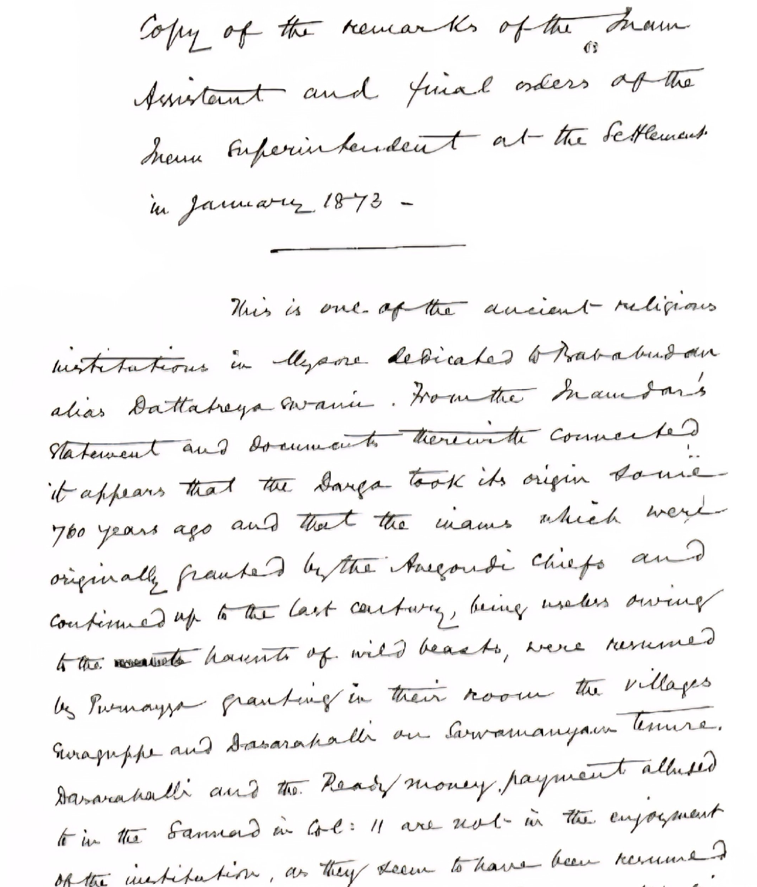
In January 1873, the Mysore Inam Settlement authorities recorded, from the Inamdar’s statement and connected documents before them, that the earlier Inams had been resumed by Purnaiyya.
The same record states that Suraguppa and Dasarahalli were granted in their place on Sarwamanyam tenure, preserving an official nineteenth-century account of an earlier reorganisation of the institution’s Inams.
Earlier administrative reorganisation · Recorded 9 January 1873 · Mysore Inam Settlement
🟡 EARLIER HISTORY · RECORDED IN A LATER OFFICIAL SOURCE
1821
THE COFFEE RECORDS BEGIN
BD-COF-1821-01
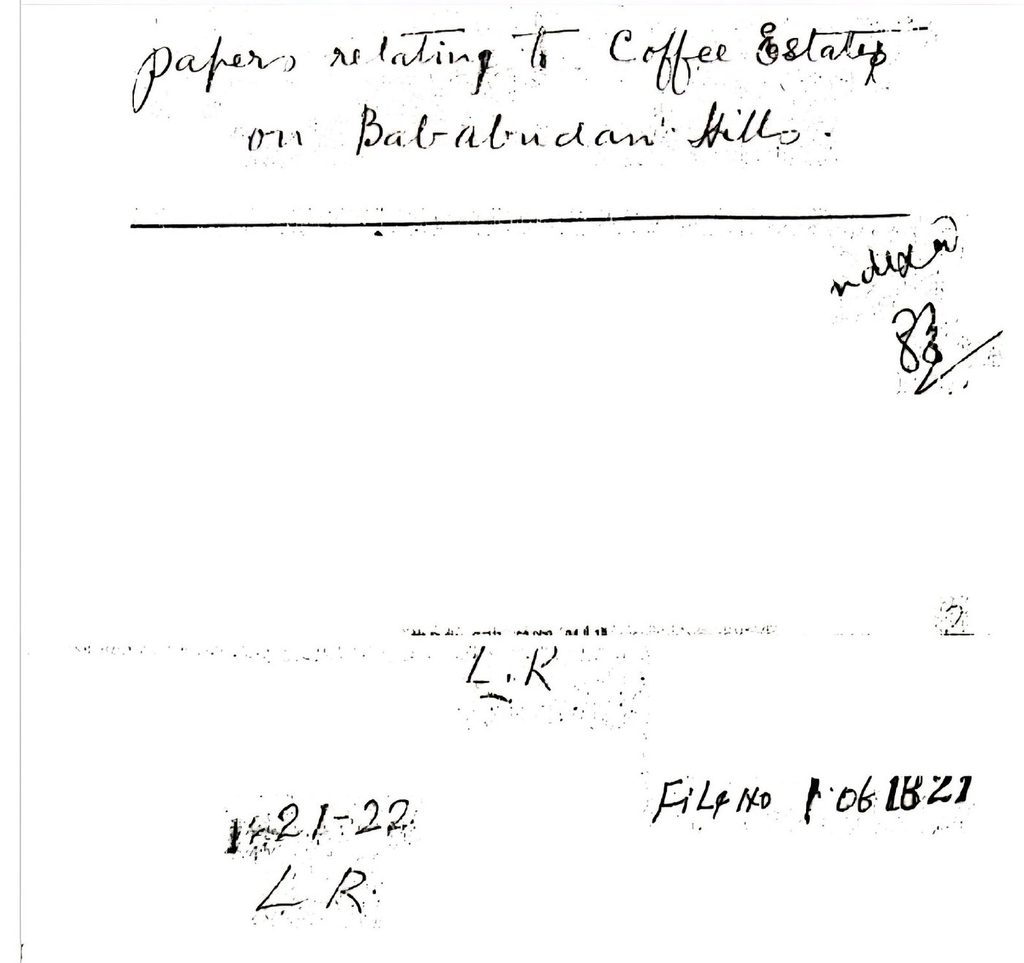
The Early Coffee Records of Baba Budan Inam Lands
This extensive archival file, dating from 1821, preserves records concerning coffee gardens and estates associated with the Baba Budan region, together with material relating to revenue, management, deeds, receipts and disputes. It forms one of the archive’s principal documentary collections for examining the early history of coffee and land administration in the Baba Budan Hills.
1821 · L.R. File No. 106/1821 · Archival Collection
🟢 PRIMARY ARCHIVAL RECORD · MULTI-DOCUMENT FILE
1829
THE COFFEE INAM NIRUP
BD-COF-1829-01
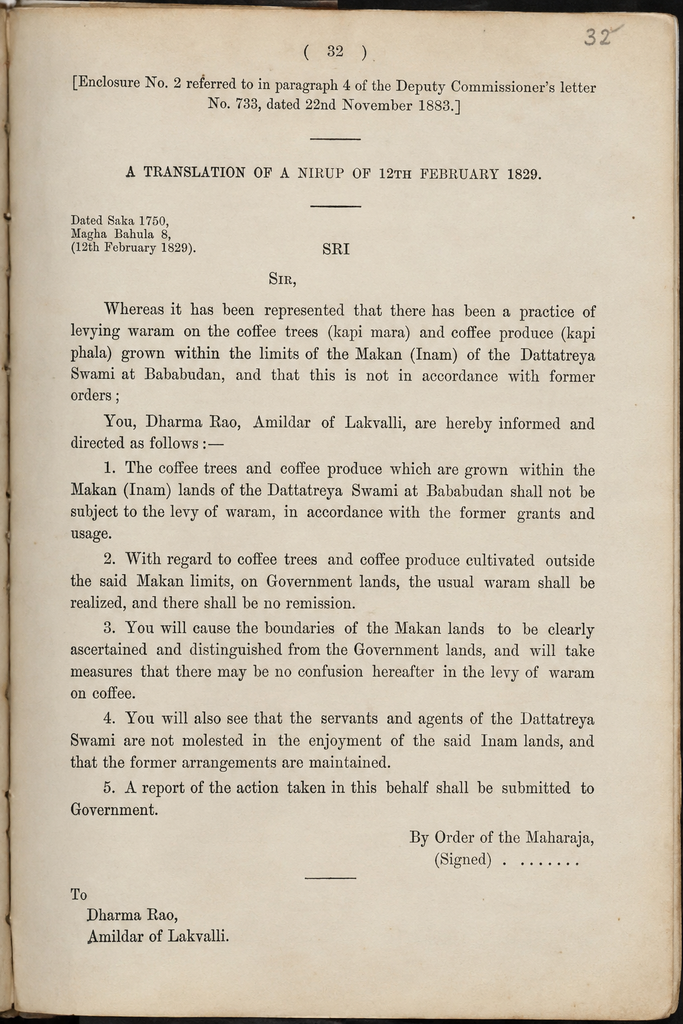
The Maharaja’s Nirup on Coffee and the Darga Lands
In 1829, a Nirup of the Maharaja of Mysore addressed to the Amildar of Lakvalli formed part of the early administrative record concerning coffee cultivation connected with the Baba Budan Darga. The order belongs to a sequence of proceedings concerning the levy of waram on coffee and the extent of the Darga’s revenue-free cultivation.
The surviving later archival record indicates that coffee cultivated within the recognised makan or Darga lands was treated differently from coffee cultivated outside those limits on Government land. The 1829 Nirup subsequently became one of the documents relied upon in nineteenth-century enquiries into the extent and character of the Darga’s coffee-land claims.
12 February 1829 · Maharaja of Mysore → Amildar of Lakvalli · Coffee & Inam Administration
🟡 EARLIER NIRUP · PRESERVED/IDENTIFIED IN LATER GOVERNMENT RECORDS
1831
THE SECOND COFFEE NIRUP
BD-COF-1831-01
The 1831 Nirup and the Baba Budan Coffee Lands
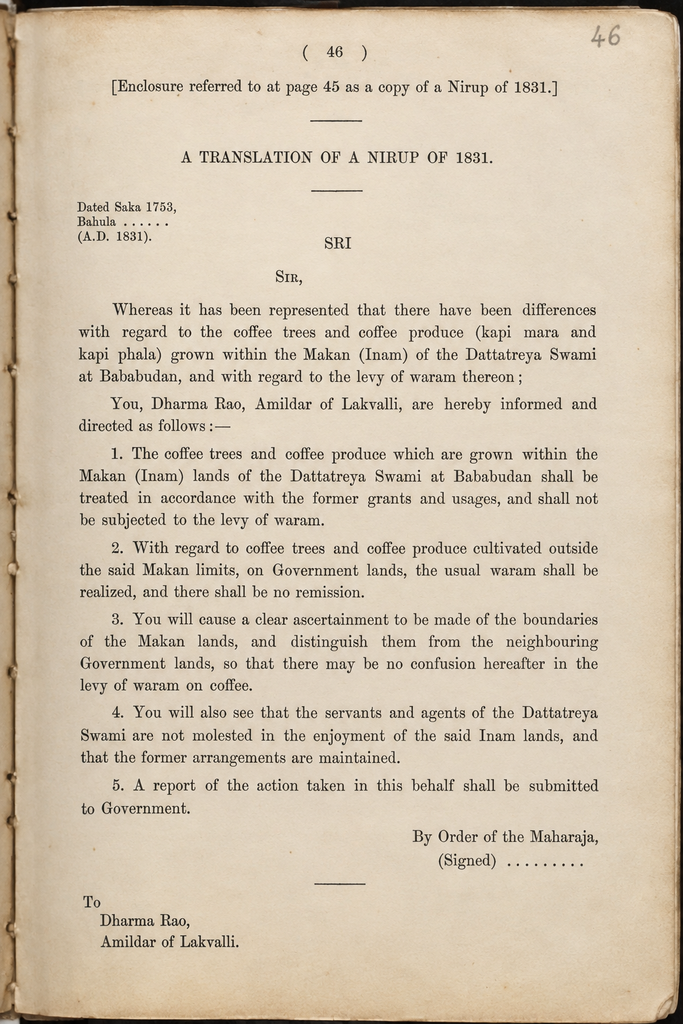
In 1831, a further Nirup formed part of the administrative record concerning the coffee lands associated with the Baba Budan institution. Preserved through a later nineteenth-century Government enquiry, the document belongs to the sequence of official orders used in examining the extent of the institution’s coffee cultivation and the distinction between its recognised lands and surrounding Government territory.
The 1831 Nirup subsequently became documentary evidence in the Government’s investigation of competing claims to coffee lands on the Baba Budan Hills, alongside earlier orders and records concerning the institution and its Inams.
1831 · Mysore Administration · Baba Budan Hills · Coffee & Inam Lands
🟡 EARLIER NIRUP · COPY/ENCLOSURE PRESERVED IN A LATER GOVERNMENT DOSSIER
1832
THE DEWAN KATCHERI NIRUP
BD-COF-1832-01
The 1832 Dewan Katcheri Order on the Coffee Inam
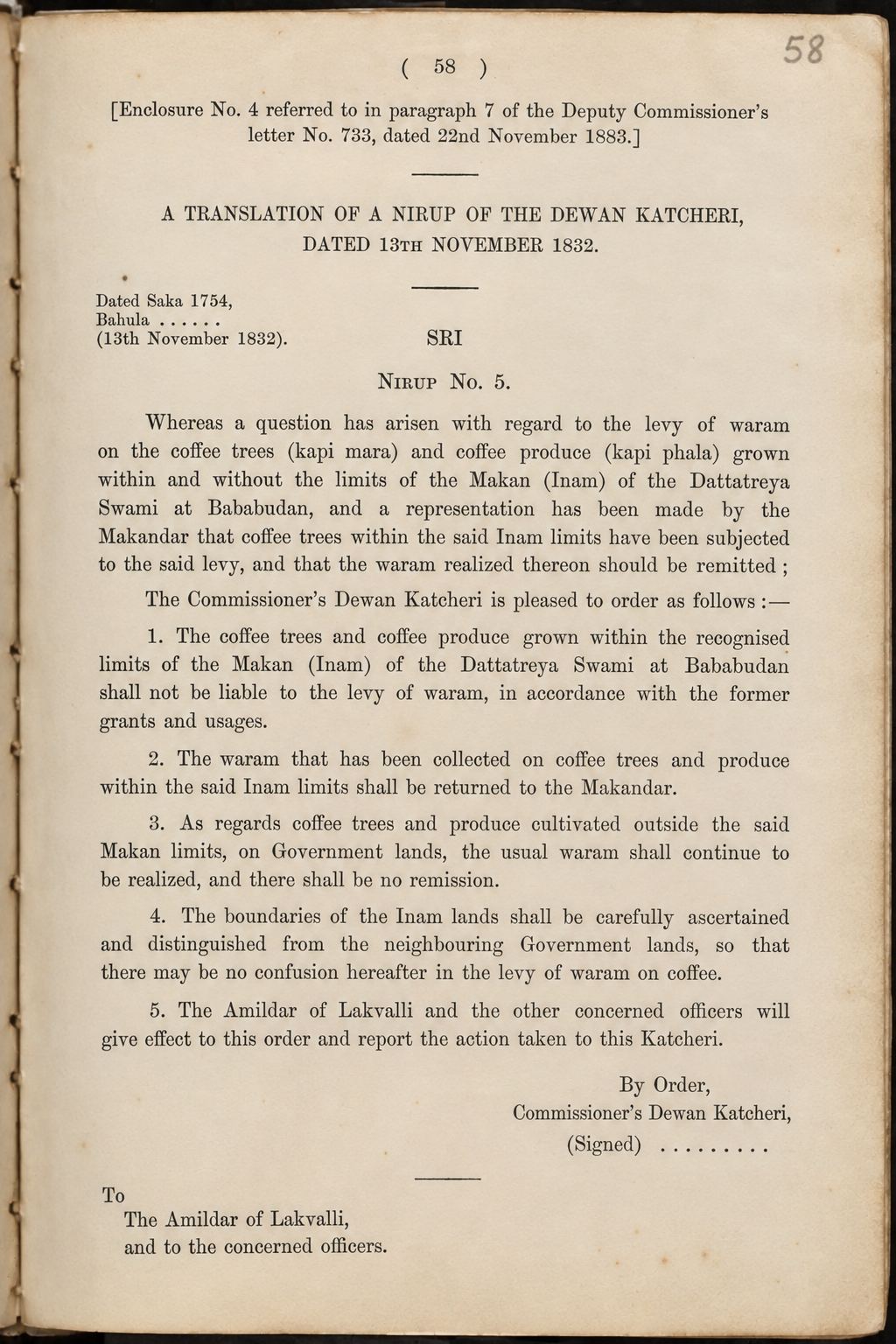
In November 1832, the Commissioner’s Dewan Katcheri issued a further Nirup in the continuing administration of the coffee lands associated with the Baba Budan institution.
The order followed disputes over the levy of waram on coffee cultivation and formed part of the documentary sequence concerning the extent and treatment of the institution’s Inam. Later nineteenth-century records preserved and relied upon this Nirup when the Government again examined the Darga’s claims to coffee lands on the Baba Budan Hills.
13 November 1832 · Commissioner’s Dewan Cutcherry · Nirup No. 5 · Coffee & Inam Administration
🟡 REFERENCED EARLIER NIRUP · PRESERVED/CITED IN LATER GOVERNMENT RECORDS
1837
THE LONG INAM RESETTLEMENT
BD-INAM-1837-01
The Long Settlement of the Baba Budan Inam Lands
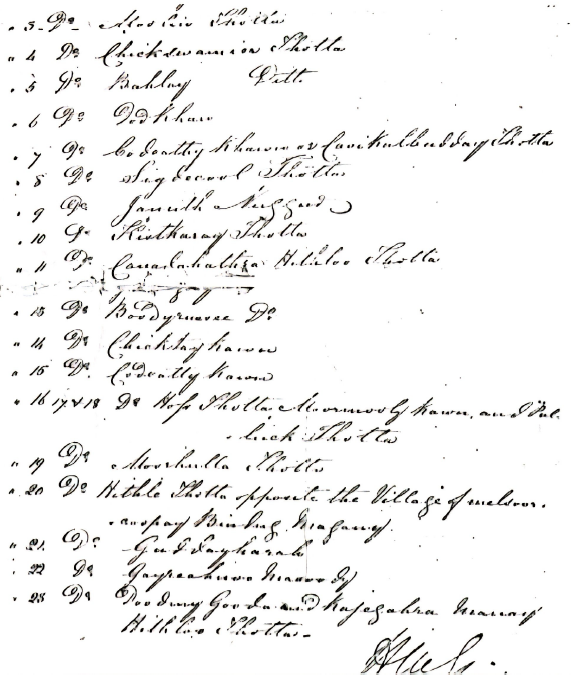
This nineteenth-century Government dossier records a prolonged administrative effort to examine and resettle the Inam lands belonging to the Bababudan Darga. The surviving papers extend across several decades and document questions of Inam rights, older sanads, coffee cultivation, revenue regulation, survey and settlement.
1837–1877 · General & Revenue Secretariat · File No. 3 of 1837
🟢 PRIMARY ARCHIVAL RECORD · MULTI-DECADE GOVERNMENT DOSSIER
1849
THE YEMME KHAN COFFEE-GARDEN TRANSACTION
BD-COF-1849-02
The Sale of the Yemme Khan Coffee Garden
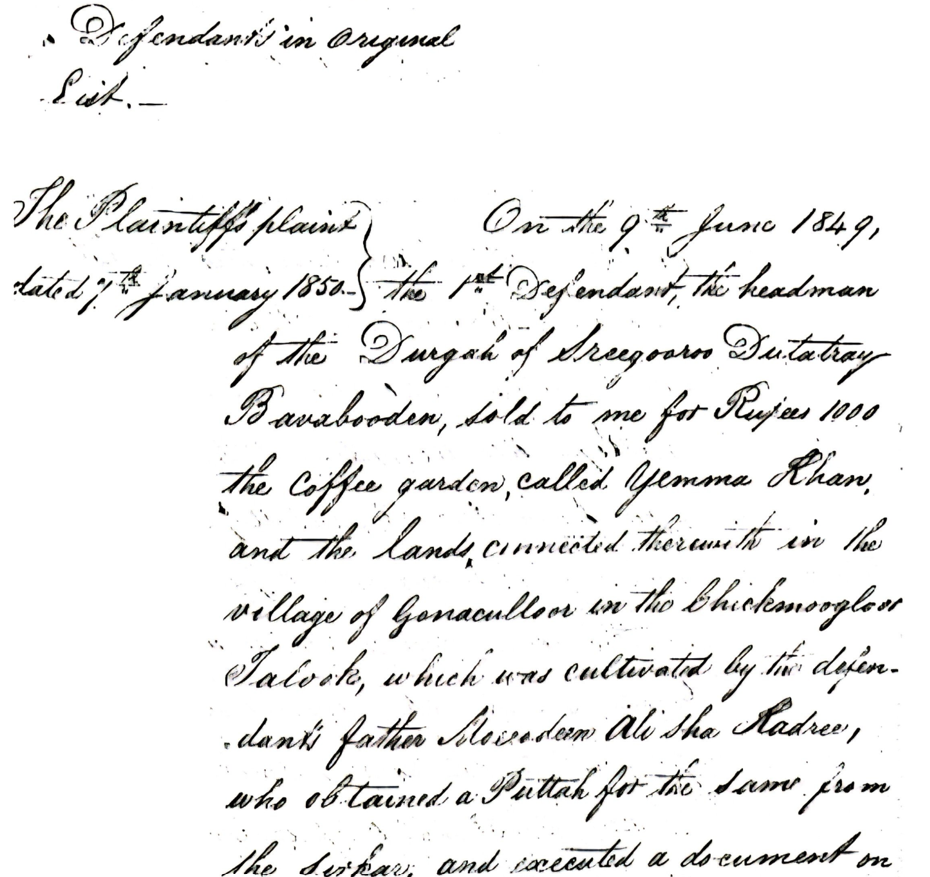
In June 1849, Syed Murthuza Shah Khadri, son of Syed Mohiudeen Ali Shah Khadri, became involved in a significant transaction concerning the Yemme Khan coffee garden on the Baba Budan Hills. The surviving documentary record traces a sale of the garden to the European planter F. D. Meppen for Rs. 1,000.
The transaction subsequently became the subject of a prolonged dispute involving members of the Khadri family, the management of the Dargah, Hakdar interests and the character of the coffee garden. Later proceedings examined the sale, payments, receipts and the authority under which the garden had been transferred.
June 1849 · Yemme Khanay Coffee Garden · Moortaja Kadry → F. D. Meppen · Rs. 1,000
🟢 DOCUMENTED TRANSACTION · PRESERVED IN THE COFFEE-ESTATE ARCHIVAL RECORD
1873
THE MYSORE INAM SETTLEMENT
BD-INAM-1873-01
Settlement of the Baba Budan Inams
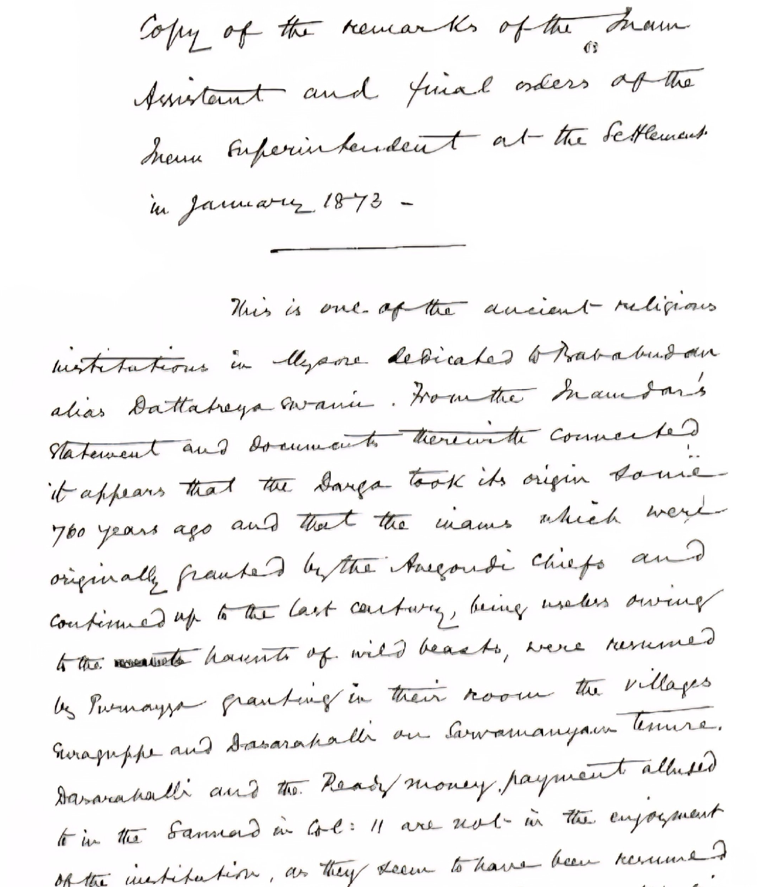
In January 1873, the Mysore Inam Settlement authorities examined the history and tenure of the Inams connected with the institution. The surviving record preserves the remarks of the Inam Assistant together with the final orders of the Inam Superintendent, drawing upon the Inamdar’s statement and documents then before the settlement authorities.
The record recounts the earlier Inams attributed to the Anegondi chiefs, their subsequent resumption under Purnaiyya, and the substitution of Suraguppa and Dasarahalli on Sarwamanyam tenure. It then records the Settlement authorities’ consideration of the institution’s Inam arrangements and associated rights and revenues.
January 1873 · Mysore Inam Settlement · Inam Assistant & Inam Superintendent
🟢 DIRECT ARCHIVAL RECORD · INAM SETTLEMENT
1884
THE SETTLEMENT OF THE BABA BUDAN INAMS
BD-INAM-1884-01
Government Settlement of the Baba Budan Inams
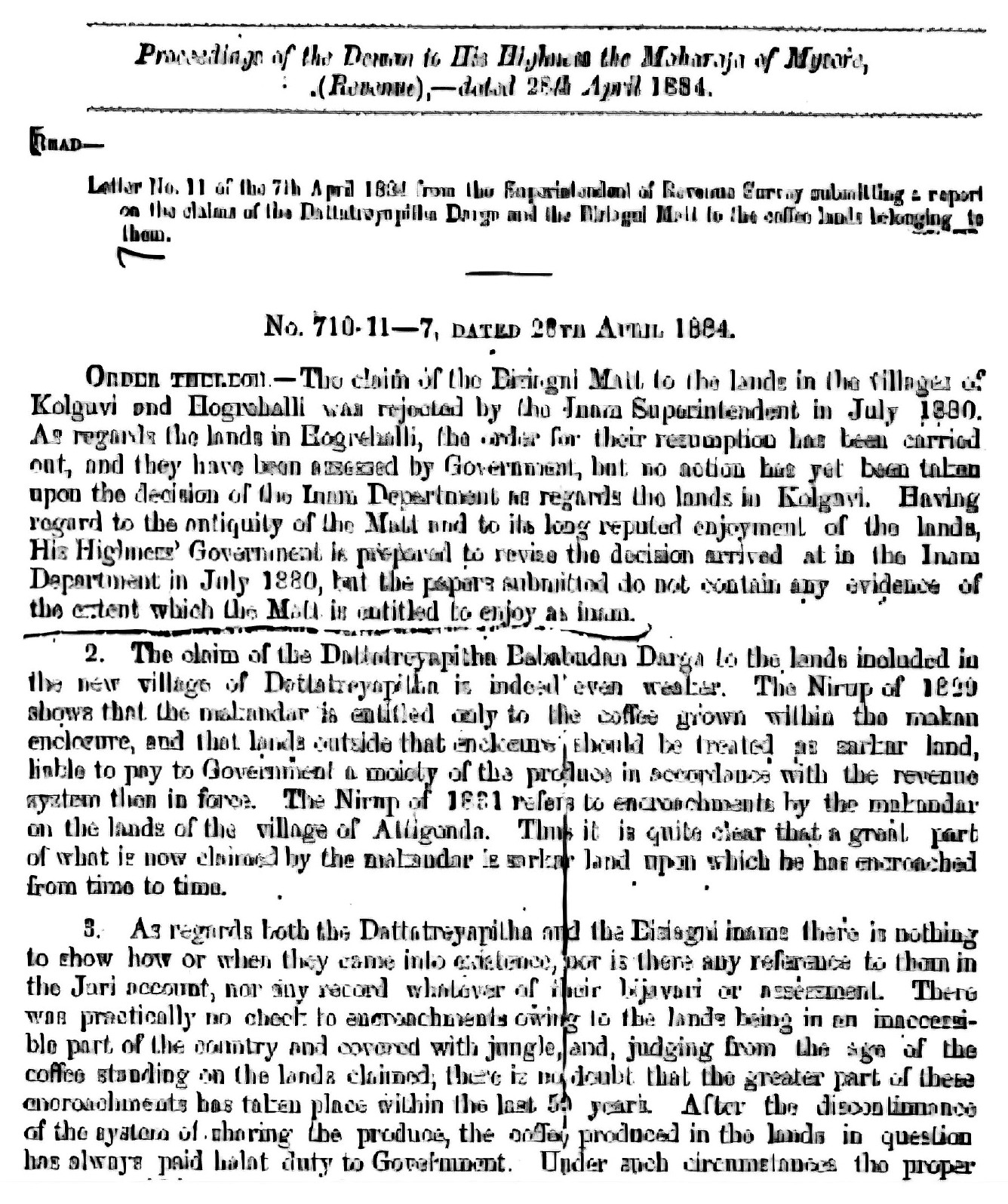
In 1884, the Government of Mysore issued orders upon the long-pending claims connected with the Inam lands of the Dattatripet Darga and the Bisagni Matt. The decision formed an important stage in the nineteenth-century settlement of the Baba Budan Inams, following decades of official inquiry into the lands, grants and competing claims associated with them.
28 April 1884 · Government of Mysore · G.O. No. 710-11-7
🟢 PRIMARY GOVERNMENT RECORD · INAM SETTLEMENT
1887
THE PROPOSED SUCCESSION OF MURTHUZA SHAH KHADRI
BD-SAJ-1887-01
Ghouse Shah Khadri’s Proposal for Adoption and Succession
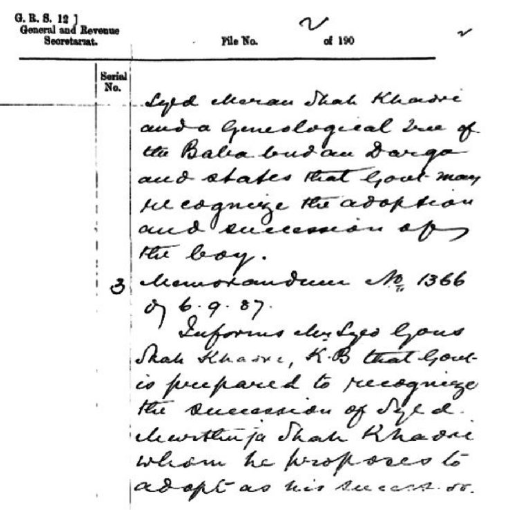
In 1887, Syed Ghouse Shah Khadri approached the Mysore Government concerning his proposed adoption of Syed Murthuza Shah Khadri and requested Government recognition of Murthuza as his intended successor in connection with the Baba Budan institution.
The surviving General & Revenue Secretariat file contains Ghouse Shah Khadri’s representation, Government correspondence and genealogical material submitted in connection with the proposal. The proceedings show that Government considered the request but distinguished the proposed future succession from an actual succession to office. A later memorandum in the file records that, until Murthuza actually succeeded, Government could not determine the honours and privileges that would attach to him.
The file therefore documents Ghouse Shah Khadri’s proposed adoption and succession arrangement in 1887; it should not be treated as evidence that Murthuza had already succeeded to the office at that date.
11 August 1887 onward · Syed Ghouse Shah Khadri · General & Revenue Secretariat (Muzrai) · File No. 391
🟢 DIRECT GOVERNMENT FILE · PROPOSED ADOPTION & SUCCESSION
1889–1893
THE NAGENAHALLI LAND ENQUIRY
BD-LAND-1889/93-01
The Nagenahalli Survey No. 53 Enquiry
This archival file records the complaint of Khan Bahadur Syed Ghouse Shah Khadri concerning Survey No. 53 at Nagenahalli. The surviving papers also contain material relating to Survey No. 138 and place the dispute within the wider nineteenth-century record of coffee settlement, Inam lands and Government revenue administration.
1889–1893 · General & Revenue Secretariat · File No. 74-89
🟢 DIRECT ARCHIVAL FILE · LAND & INAM RECORD
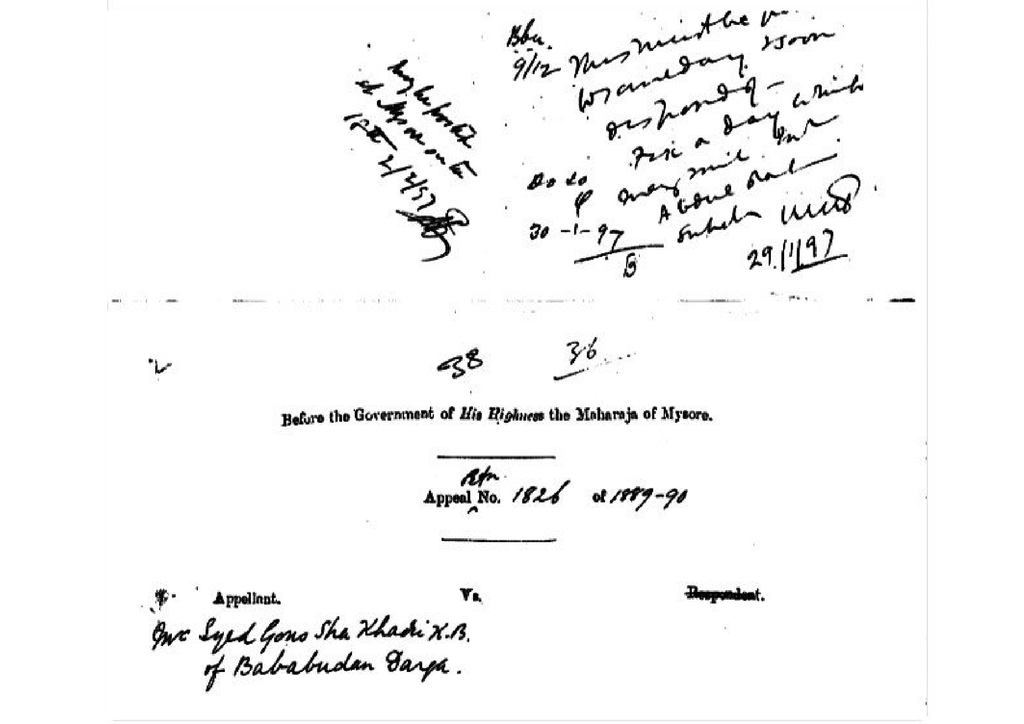
Government appeal proceedings concerning Syed Ghouse Shah Khadri and the Nagenahalli land dispute, Appeal No. 1826 of 1890–91.
1889
THE ISUF ALI SHAH KHADRI LAND CLAIM
BD-LAND-1889-02
The Dattatreya Inam Village Land Enquiry
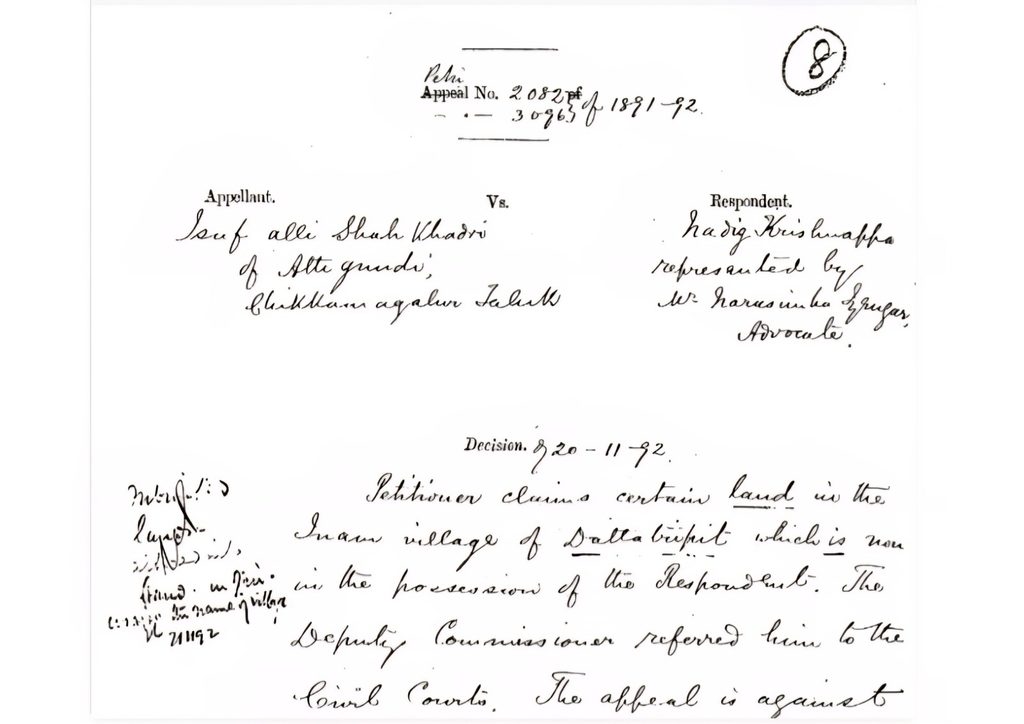
In December 1889, Isuf Ali Shah Khadri of Attigundi submitted a claim concerning land in the Inam village of Dattatreya. The surviving General & Revenue Secretariat file records an official enquiry into the claim and its connection with a coffee garden said to have been acquired through a Civil Court sale.
The proceedings examine possession, earlier transactions, documentary evidence, boundaries and the physical identification of the disputed land. Revenue officials also caused the land to be measured during the enquiry. The surviving record does not establish a final Revenue Department determination of title in Isuf Ali Shah Khadri’s favour; the dispute was treated as one requiring recourse to the Civil Court.
11 December 1889 onward · Isuf Ali Shah Khadri · Attigundi · Dattatreya Inam Village · General & Revenue Secretariat · File No. 32-89
🟢 DIRECT ARCHIVAL FILE · LAND-CLAIM & REVENUE ENQUIRY
1891
THE KHADER BASHA COFFEE-ESTATE SALE PROCEEDING
BD-COURT-1891-01
Court Sale Proceedings Involving Syed Khader Basha Khadri
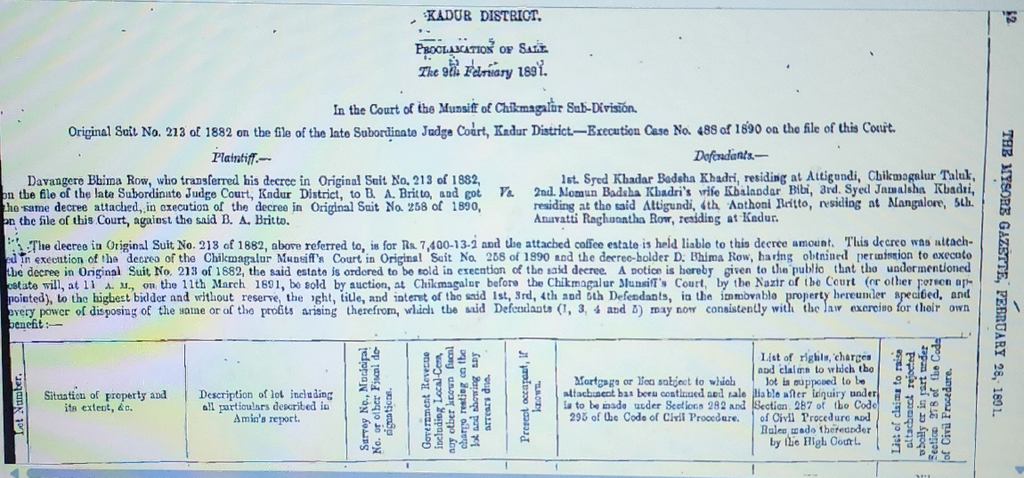
On 9 February 1891, the Court of the Munsiff of the Chikmagalur Sub-Division issued a proclamation of sale in execution proceedings arising from Original Suit No. 213 of 1882. The record names Syed Khader Basha Khadri of Attigundi among the defendants and concerns a coffee estate attached in execution of the decree.
The surviving proclamation provides unusually detailed information about the estate, including its survey number, extent, boundaries, coffee cultivation and estimated value. It records Survey No. 296 with an extent of 127 acres and 23 guntas and describes approximately 25,000 coffee plants in bearing and about 15,000 not yet bearing. The document is evidence of a judicial execution and proposed sale involving the property; it should not by itself be treated as establishing the ultimate ownership or later legal status of the estate.
9 February 1891 · Court of the Munsiff, Chikmagalur Sub-Division · Original Suit No. 213 of 1882 · Execution Case No. 488 of 1890
🟢 DIRECT COURT RECORD · EXECUTION & COFFEE-ESTATE SALE
1902
SUCCESSION TO THE SAJJADA & MANAGEMENT
BD-SAJ-1902-01
Government Recognition of Syed Murthuza Basha Khadri
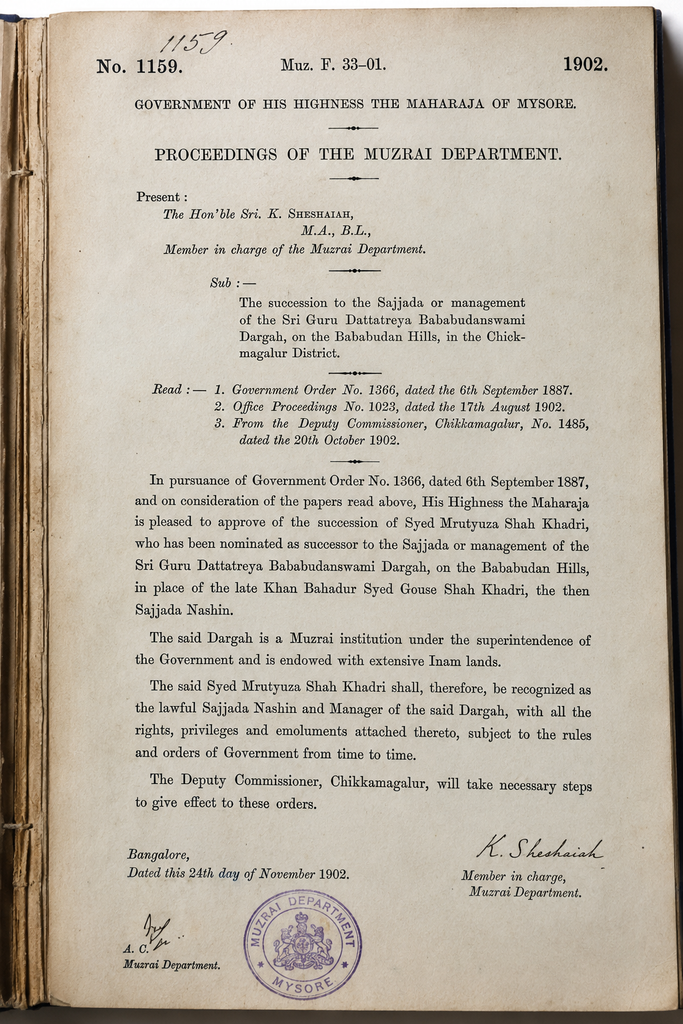
On 24 November 1902, the Muzrai Department of the Government of Mysore issued Proceedings No. 1159 concerning succession to the Sajjada or management of the institution. The proceeding approved Syed Murthuza Basha Khadri as successor to the late Khan Bahadur Syed Ghouse Shah Khadri and records the institution within the contemporary framework of Government-supervised Muzrai administration.
24 November 1902 · Government of Mysore · Muzrai Proceedings No. 1159 · Muz. F.33-01
🟢 DIRECT GOVERNMENT RECORD · SAJJADA & SUCCESSION
1901–02
THE JAMAL SHAH & KHADER BASHA PETITION
BD-PET-1901/02-01
Petition Regarding the Succession of the Makandar
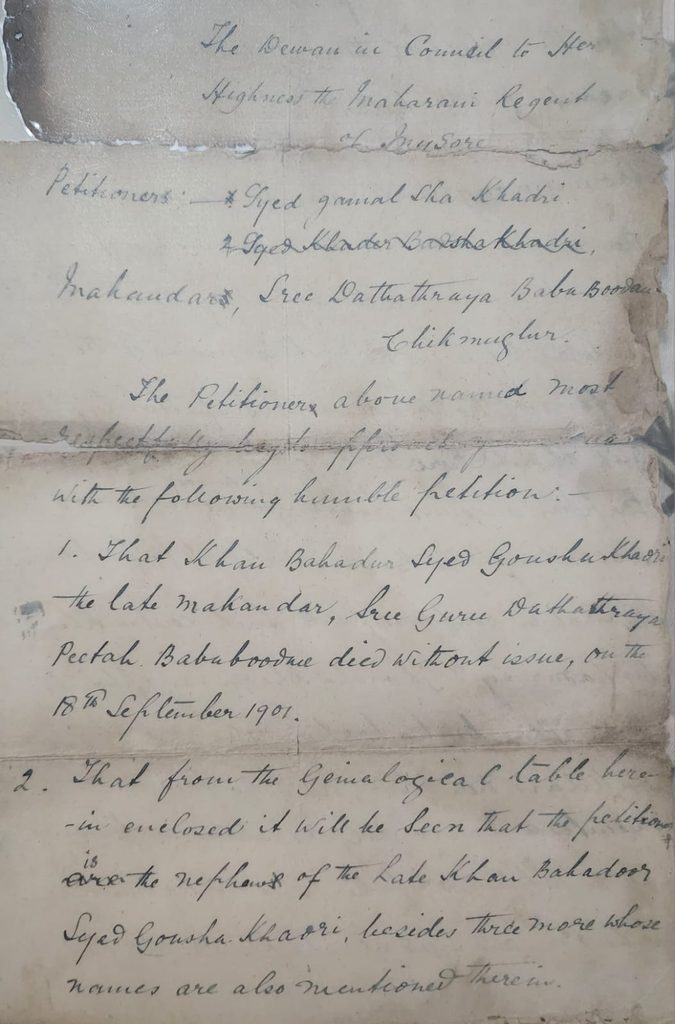
Following the death of Khan Bahadur Syed Ghouse Shah Khadri in September 1901, Syed Jamal Shah Khadri and Syed Khader Basha Khadri submitted a petition to the Dewan in Council of the Maharani Regent of Mysore concerning the succession to the office associated with the institution.
The petitioners mentioned the account of the customary role of the Hakdars in selecting a successor, referred to earlier Karar arrangements, and objected to the proposed appointment of Syed Murthuza Basha Khadri through Syed Shahali Hussaini. They asked Government to cancel the proposed appointment and also raised questions concerning Hakdar participation in the income of the coffee estates. These statements record the petitioners’ claims and objections during the succession dispute; they do not by themselves establish the validity of the asserted custom or determine the eventual succession.
1901–02 · Syed Jamal Shah Khadri & Syed Khader Basha Khadri · Dewan in Council · Maharani Regent of Mysore · Sajjada/Makandar Succession
🟢 DIRECT PETITION · SUCCESSION & HAKDAR CLAIMS
1902–03
THE HAKDAR & INAM-PROFITS ENQUIRY
BD-HAK-1902/03-01
Government Enquiry into Claims to the Profits of the Inams
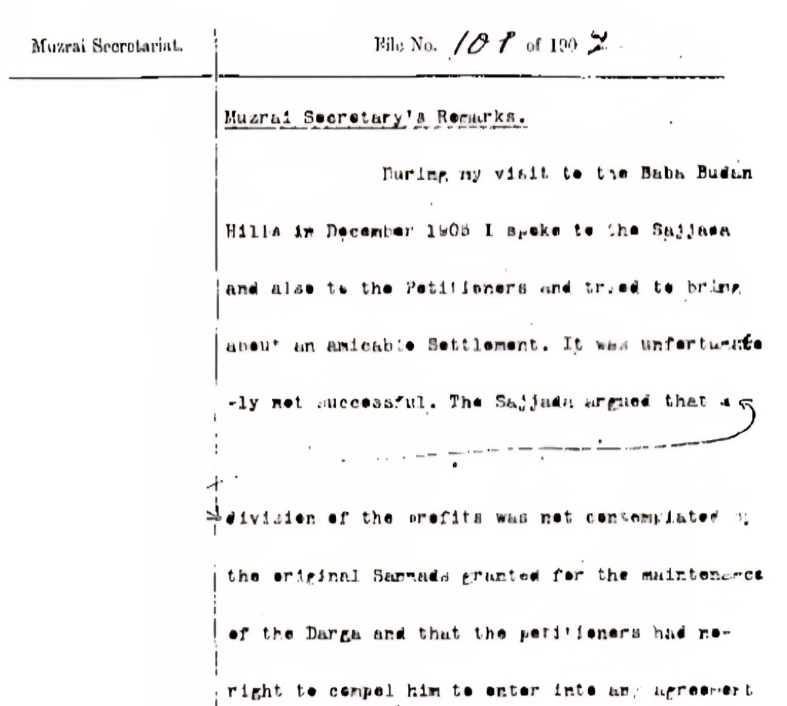
Following the succession proceedings of 1902, the Mysore Government separately examined claims advanced by Syed Jamal Shah Khadri and others concerning participation in the profits associated with the Inams of the Baba Budan institution.
The surviving file records competing positions concerning earlier Karars, the rights claimed by members of the Khadri family, the income required for maintenance of the institution, and whether earlier arrangements with former Sajjadas created an obligation upon the succeeding office-holder. During a visit to the Baba Budan Hills in December 1902, the Muzrai Secretary attempted an amicable settlement between the Sajjada and the petitioners, but the effort was unsuccessful.
1902–03 · General & Revenue Secretariat (Muzrai) · File No. 101 · Hakdar & Inam-Profit Claims
🟢 DIRECT GOVERNMENT FILE · HAKDAR & INAM-PROFITS ENQUIRY
12 FEBRUARY 1903
THE SHAHALI HUSSAINI MANAGEMENT CLAIM
BD-PET-1903-02
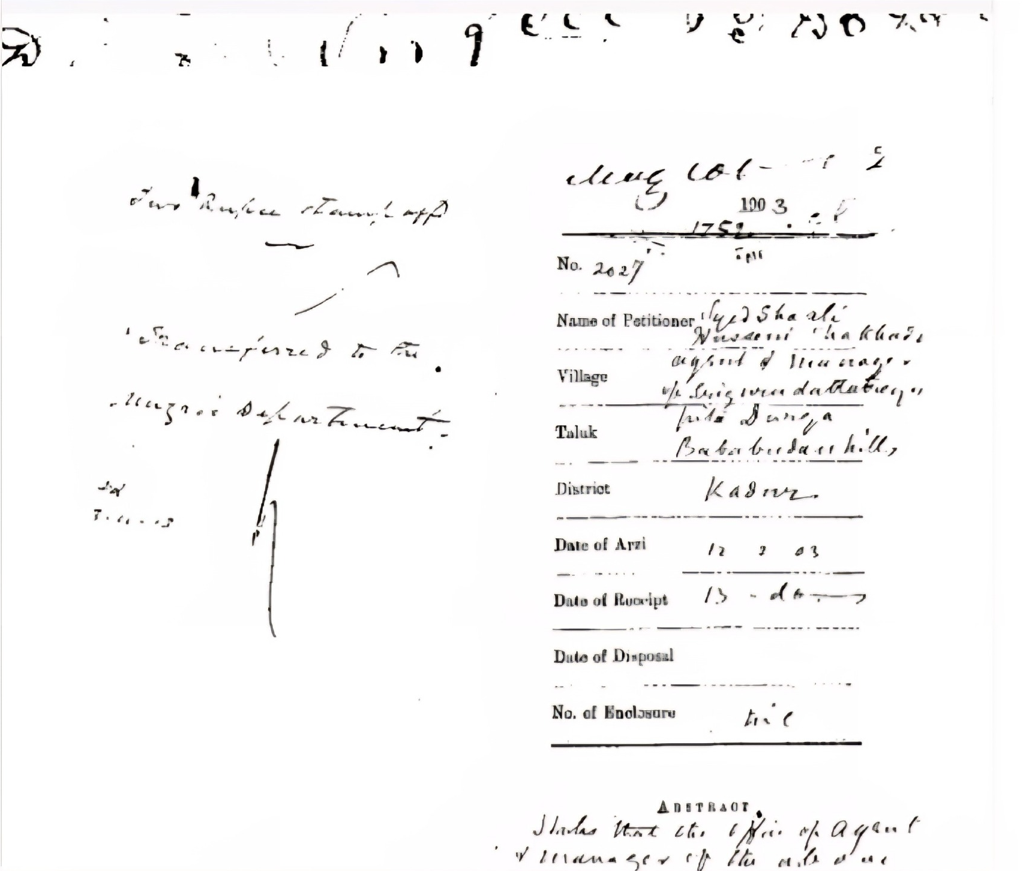
Petition Concerning Agency and Management of the Baba Budan Institution
In February 1903, Syed Shahali Hussaini Shahkhadri presented a petition concerning his claimed right to participate in the management of the Baba Budan institution.
In support of his position, Shahali relied upon earlier family arrangements and upon a General Power of Attorney dated 1 April 1896, under which he maintained that the late Syed Ghouse Shah Khadri had appointed him Agent of the Darga in succession to his father, who had also acted as agent.
The surviving Government record is particularly significant because it distinguishes a claimed agency or management authority from succession to the office of Sajjada. Later official examination of the claim records that Shahali had not established an ultimate right to the office of manager. The documents therefore evidence the claim and the administrative enquiry into it, rather than establishing permanent managerial title.
12 February 1903 · Syed Shahali Hussaini Shahkhadri · General & Revenue Secretariat / Muzrai · File No. 101
🟢 DIRECT PETITION & GOVERNMENT ENQUIRY · AGENCY/MANAGEMENT CLAIM
26 FEBRUARY 1903
PETITION OF SYED GAYASUDDIN SHAH KHADRI
BD-PET-1903-01
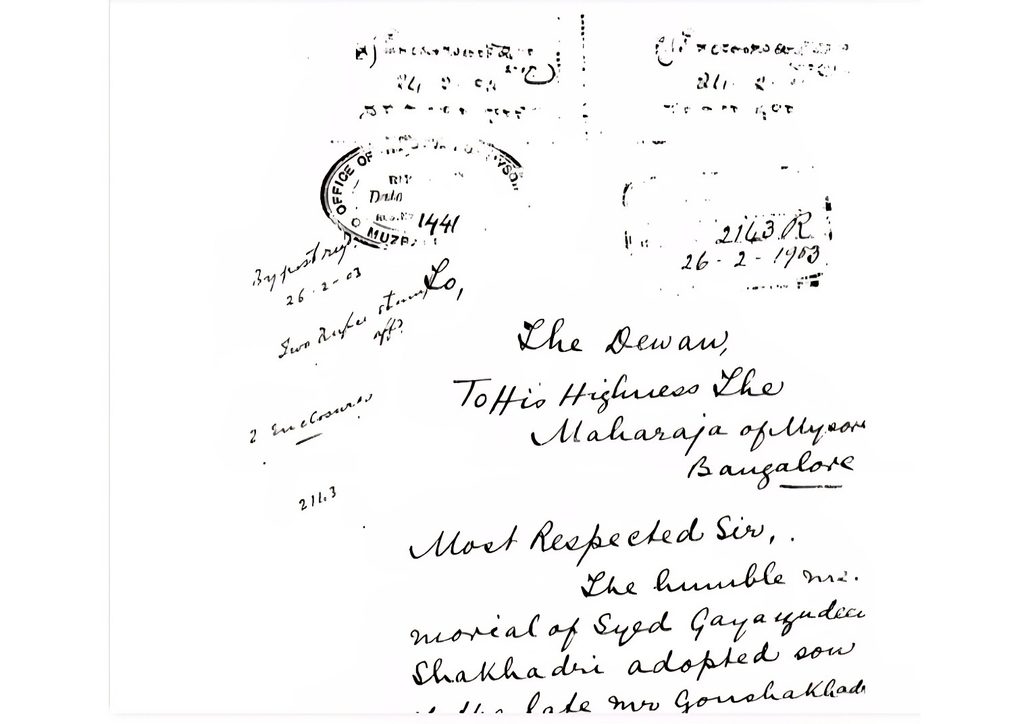
Petition Concerning Adoption, Heirship and the Management of the Baba Budan Institution
In February 1903, Syed Gayasuddin Shah Khadri submitted a memorial to the Maharaja of Mysore following the Government recognition of Murthuza Basha as manager and Sajjada of the Baba Budan Hills institution.
Gayasuddin advanced his own claim as the alleged adopted son of the late Khan Bahadur Syed Ghouse Shah Khadri and referred to documents and earlier proceedings which he maintained supported his position. His memorial also referred to an earlier Karar and challenged the circumstances surrounding Murthuza Basha’s recognition.
The petition is important evidence of the competing claims presented to the Mysore Government following the death of Syed Ghouse Shah Khadri. The document records Gayasuddin’s assertions; it does not, by itself, establish the alleged adoption, heirship or genealogical relationship as historical fact.
26 February 1903 · Syed Gayasuddin Shah Khadri · Maharaja of Mysore · Enclosure in General & Revenue Secretariat File No. 101
🟢 DIRECT PETITION · COMPETING SUCCESSION/MANAGEMENT CLAIM
1907–08
THE ADDITIONAL CASH GRANT
BD-TAS-1907/08-01
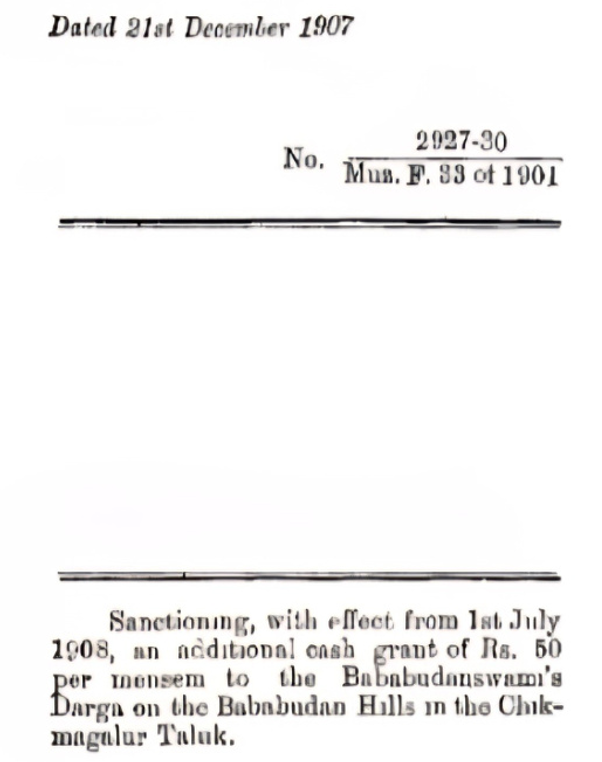
Government Sanction of an Additional Rs. 50 per Month to Baba Budan institution
In proceedings dated 21 December 1907, the Government of Mysore considered the financial requirements of the Baba Budan institution and reviewed an earlier cash grant of Rs. 50 per month that had been sanctioned with effect from 1 July 1906.
After examining the income available from the institution’s Inams and the expenditure connected with its religious and charitable purposes, Government sanctioned an additional cash grant of Rs. 50 per month, to take effect from 1 July 1908.
The proceeding forms part of the Muzrai administration of the institution and records Government financial assistance in addition to the revenues associated with its Inam endowments. The cash grant should therefore be distinguished from the Inam lands themselves and should not be interpreted as a grant of ownership in those lands.
21 December 1907 · Government of Mysore · Muzrai Department · No. 2927-30 · Muz. F.33 of 1901
🟢 DIRECT GOVERNMENT PROCEEDING · MUZRAI CASH GRANT
1912–14
THE MUZRAI ENQUIRY AT ATTIGUNDI
BD-MUZ-1912/14-01
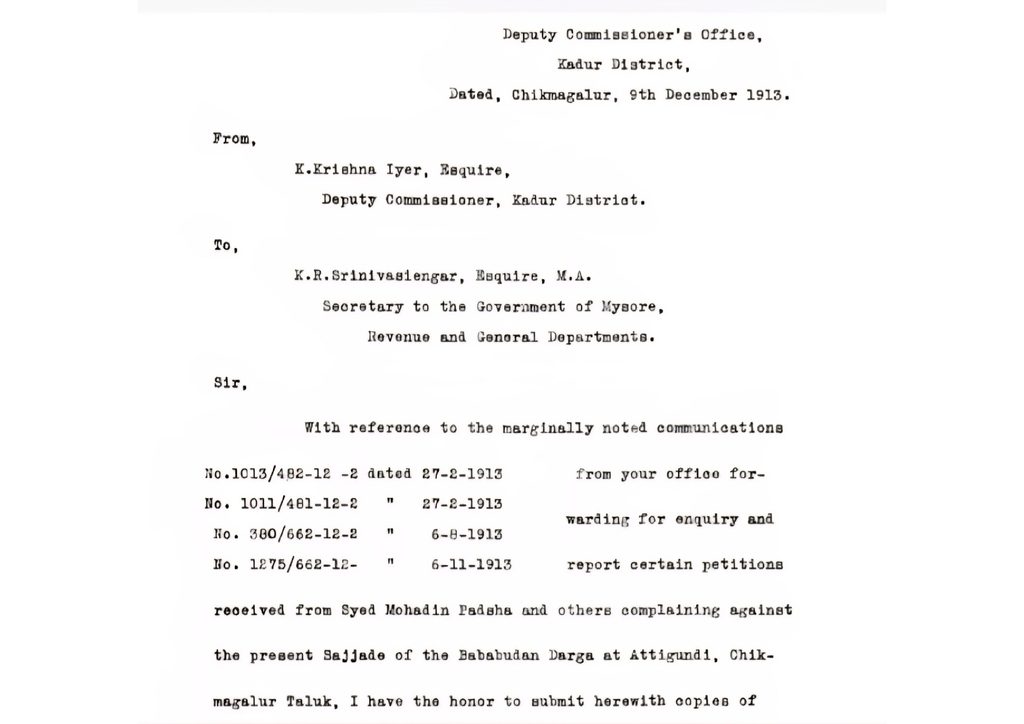
Government Enquiry into the Administration of the Baba Budan Institution
Beginning in 1912, complaints concerning the administration of the Baba Budan Darga led to an extended enquiry by the Mysore authorities.
During 1913, the Chikmagalur Taluk Amildar conducted enquiries into allegations concerning the management of the institution, its accounts, arrangements for pilgrims, internal administration and the use of its revenues. The enquiry included a personal visit to the Baba Budan Dargah, examination of the parties and scrutiny of the administration.
The proceedings also considered claims concerning participation in the income of the institution’s Inams. In examining these claims, officials referred to earlier Government proceedings treating the Inams as Devadaya endowments intended for the maintenance of the institution and its religious and charitable purposes rather than division into personal shares.
The enquiry continued into 1914 with further administrative consideration of the institution and questions concerning certain Inam lands.
1912–14 · General & Revenue Secretariat (Muzrai) · File No. 662 of 1912 · Attigundi · Kadur District
🟢 DIRECT GOVERNMENT DOSSIER · MUZRAI ADMINISTRATION & INAM ENQUIRY
1913
THE RAHADARI OF THE SAJJADA
BD-ADM-1913-01
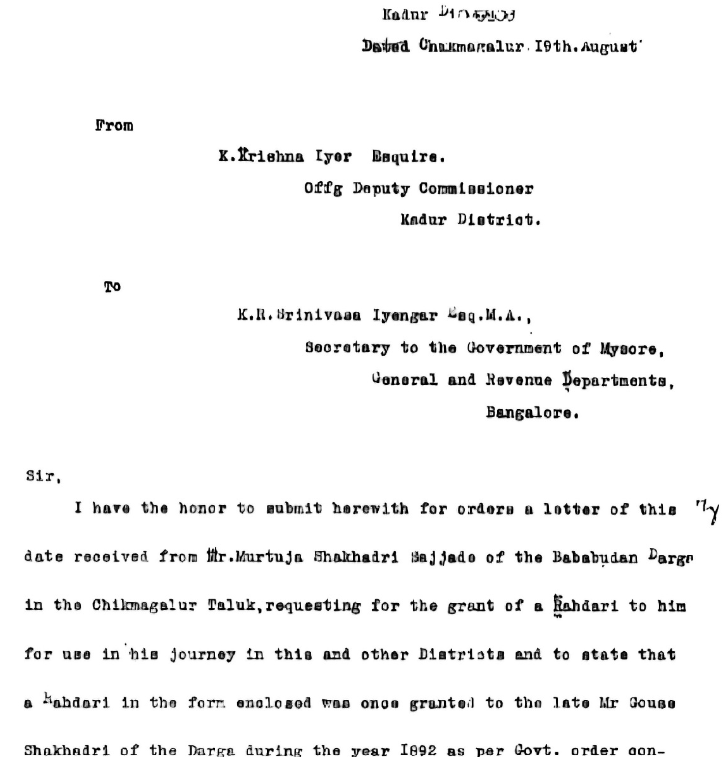
Government Authorization for the Sajjada’s Rahadari
In August 1913, the Sajjada of the Baba Budan Darga applied through the Kadur district administration for a Rahadari in connection with an intended journey through parts of Mysore.
The resulting Government file examined earlier precedents for such passes, including a Rahadari issued to the late Syed Ghouse Shah Khadri in 1892. Officials also considered subsequent Government policy concerning the continued use of Rahadaris and comparable arrangements made for the heads of other religious institutions.
Following this correspondence, authority was given for a Rahadari to be issued on the lines of the earlier 1892 precedent. The proceedings provide a rare documentary record of the administrative arrangements associated with the Sajjada’s travel beyond the Baba Budan institution.
1913 · General & Revenue Secretariat (Muzrai) · File No. 91 of 1913 · Kadur District
🟢 DIRECT GOVERNMENT FILE · RAHADARI & ADMINISTRATIVE PRIVILEGES
1916–17
THE TASDIK FOR FEEDING PILGRIMS
BD-TAS-1916-01
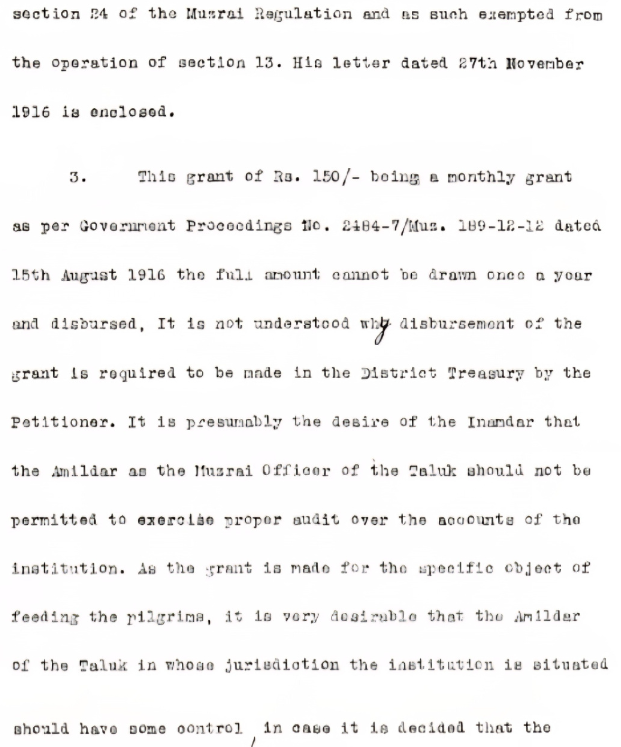
The Rs. 150 Monthly Tasdik of the Baba Budan Institution
In 1916, the Mysore Government sanctioned a Tasdik of Rs. 150 per month for the Baba Budan Darga at Chikmagalur, amounting to Rs. 1,800 annually.
The surviving Muzrai file records that the grant was made for the specific purpose of feeding pilgrims. Subsequent correspondence considered how the sanctioned amount should be drawn and disbursed, and whether it should continue to be paid monthly through the Taluk administration or be released in a larger annual payment.
The proceedings also considered the maintenance and inspection of the institution’s accounts. The district authorities regarded administrative oversight as particularly relevant because the Tasdik was a Government grant intended for a specified charitable purpose.
15 August 1916 onward · Government of Mysore · General & Revenue Secretariat (Muzrai) · File No. 423-16 · Proceedings No. 2484–7
🟢 DIRECT GOVERNMENT FILE · TASDIK & PILGRIM FEEDING
1925–26
THE NOMINATION OF GHOUSE MOHIUDDIN
BD-SAJ-1925-01
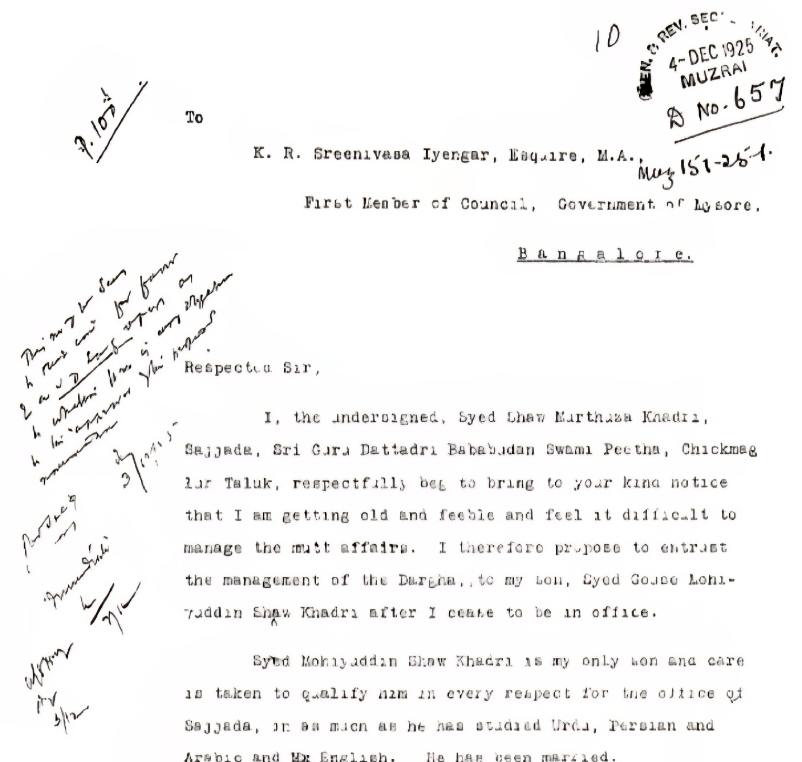
Murthuza Basha Khadri’s Proposal for Ghouse Mohiuddin to Assist and Succeed Him
In December 1925, Syed Murthuza Basha Khadri, Sajjada of the Baba Budan institution, approached the Mysore Government concerning the future management of the Darga. Describing himself as becoming old and feeble, he proposed entrusting the management to Ghouse Mohiuddin.
Murthuza also informed Government that he contemplated undertaking a pilgrimage to Mecca and requested sanction for the proposed arrangement. The matter subsequently led to enquiries by the district and Muzrai authorities during 1926 concerning whether there was any objection to Ghouse Mohiuddin carrying on the duties of the Sajjada during his father’s absence.
The surviving proceedings record that the authorities found no objection to the proposed temporary arrangement. The file therefore documents Murthuza Basha Khadri’s nomination and Government consideration of his temporary performance of the Sajjada’s duties; it should not by itself be treated as evidence of a permanent succession to the office in 1926.
2 December 1925 onward · Syed Murthuza Basha Khadri · General & Revenue Secretariat (Muzrai) · File No. 151-25
🟢 DIRECT GOVERNMENT FILE · NOMINATION & TEMPORARY SUCCESSION ARRANGEMENT
1930
THE RENEWED MANAGEMENT CLAIM
BD-HAK-1930-01
Government Reconsideration of the Hakdar and Management Claims
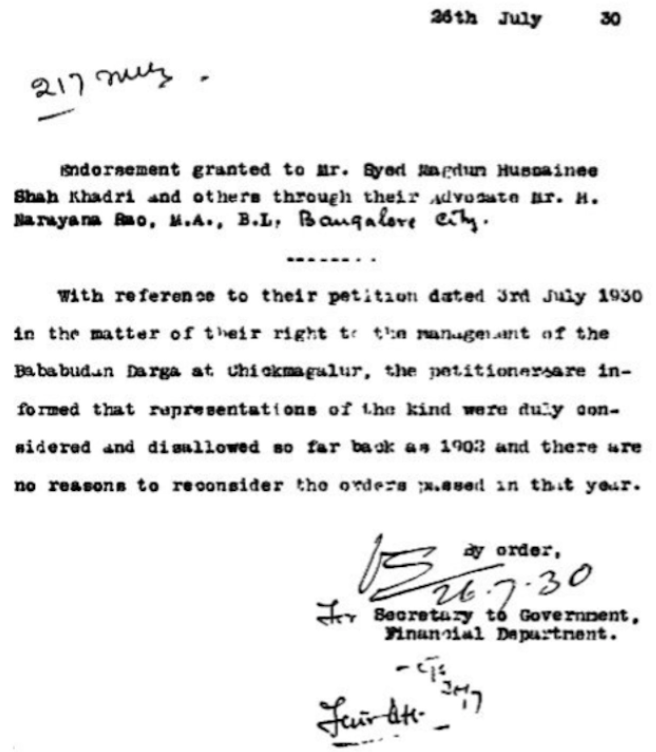
In July 1930, Syed Magdum Hussainie Shah Khadri and other petitioners approached the Mysore Government seeking reconsideration of claimed rights connected with the management of the Baba Budan institution.
The resulting Muzrai proceedings reviewed the earlier history of the dispute and referred directly to the Government’s consideration of similar claims in 1902. The official note recorded that claims by branches of the manager’s family to participate in the income of the institution’s endowments had previously been considered and disallowed.
In explaining its position, the Government record described the cash and land endowments as Inam grants maintained for the institution and concluded that the earlier orders did not require reconsideration. The petitioners were accordingly informed in July 1930 that Government found no reason to reopen the orders passed in 1902.
The file records the Mysore Government’s administrative position in 1930 and its reliance upon the earlier proceedings; it should be read as an administrative determination within that historical context rather than as a modern adjudication of property title.
3–26 July 1930 · Syed Magdum Hussainie Shah Khadri & others · General & Revenue Secretariat (Muzrai) · File No. 25 of 1930–31
🟢 DIRECT GOVERNMENT FILE · MANAGEMENT & ENDOWMENT CLAIMS
1932
THE ARCHAEOLOGICAL RECORD OF THE BABA BUDAN HILLS
BD-ARCH-1932-01
Inscriptions and Historical Objects Recorded on the Baba Budan Hills
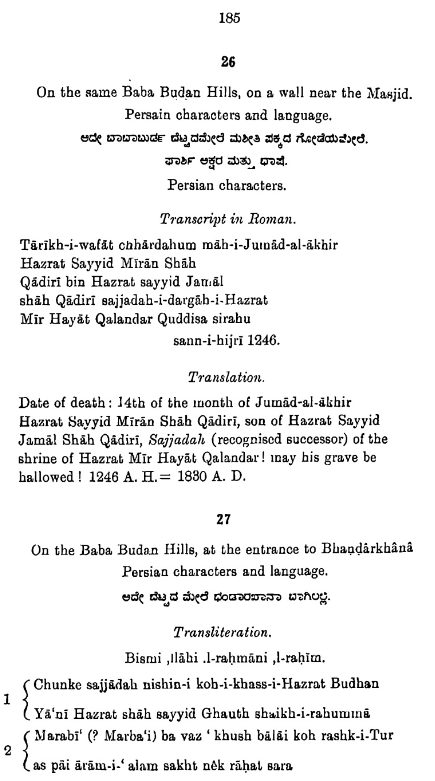
During the archaeological survey of the Baba Budan Hills, the Mysore Archaeological Department documented a group of inscriptions and historical objects associated with the shrines and religious landscape of the mountain.
Among the records was a Persian inscription at the Dada Hayat shrine containing a date corresponding to 396 AH / 1005 AD. A second Persian inscription, recorded on a wall near the Masjid, identifies Syed Meeran Shah Khadri as the son of Syed Jamal Shah Khadri and Sajjada of the shrine of Hazrat Mir Hayat Qalandar, and records his death in 1246 AH / 1830 AD.
The survey also recorded an inscription at the entrance to the Bhandarkhana referring to Hazrat Budhan and Shah Sayyid Ghauth, describing the construction of a spring-house for visitors and giving the date 1269 AH / 1852 AD. Finally, it documented a Kannada inscription on a silver stick in the Dattatreya Matha, translated as “Sri Krishna” and “To Sri Dattatreya-pitha,” which the Archaeological Department attributed to Krishnaraja Wodeyar III.
Recorded 1932 · Mysore Archaeological Department · Baba Budan Hills · Inscriptions Nos. 25–28
🟢 DIRECT ARCHAEOLOGICAL RECORD · EPIGRAPHY & MATERIAL CULTURE
1934
THE MYSORE MUZRAI MANUAL
BD-MUZ-1934-01
Guru Dattatreya Bababudan Swamy’s Darga
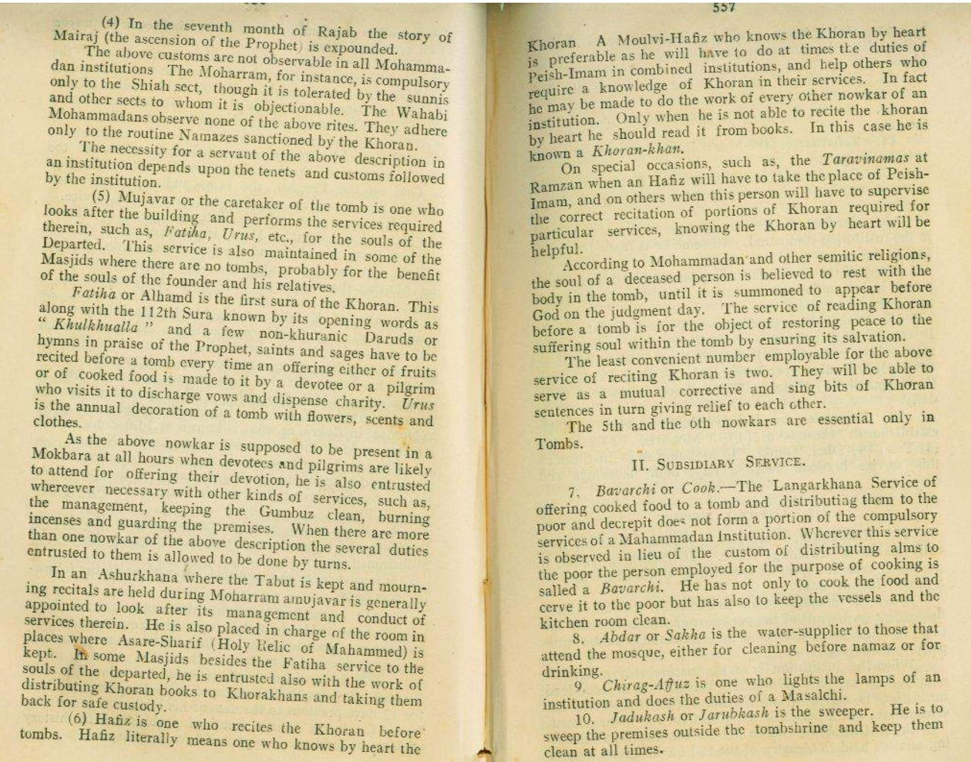
In the Revised Mysore Muzrai Manual, the Mysore Government recorded the institution on the Bababudan Hills under the heading “Guru Dattatreya Bababudan Swamy’s Darga.”
The Manual described it as an ancient and important institution held in high esteem by Hindus and Mohammadans alike, and recorded that pilgrims visited it from different parts of India. It identified the head of the institution as the Sajjada and described the administrative framework governing succession to that office.
Significantly, the Manual recorded that the Darga was endowed with the Inam villages of Suraguppe, Dattatreya Peeta and Jannath Nagara, together with an annual cash grant of Rs. 1,800. The entry provides a concise official description of the institution, its administration and its endowments as recorded by the Mysore Government in 1934.
1934 · Government of Mysore · Revised Mysore Muzrai Manual · Chapter XI — Mohammadan Institutions · p. 571
🟢 DIRECT OFFICIAL SOURCE · INSTITUTIONAL ADMINISTRATION & INAM ENDOWMENTS
1941
THE HAZRATH BASHA SUCCESSION OBJECTION
BD-PET-1941-01
Petition Concerning the Proposed Sajjada Succession
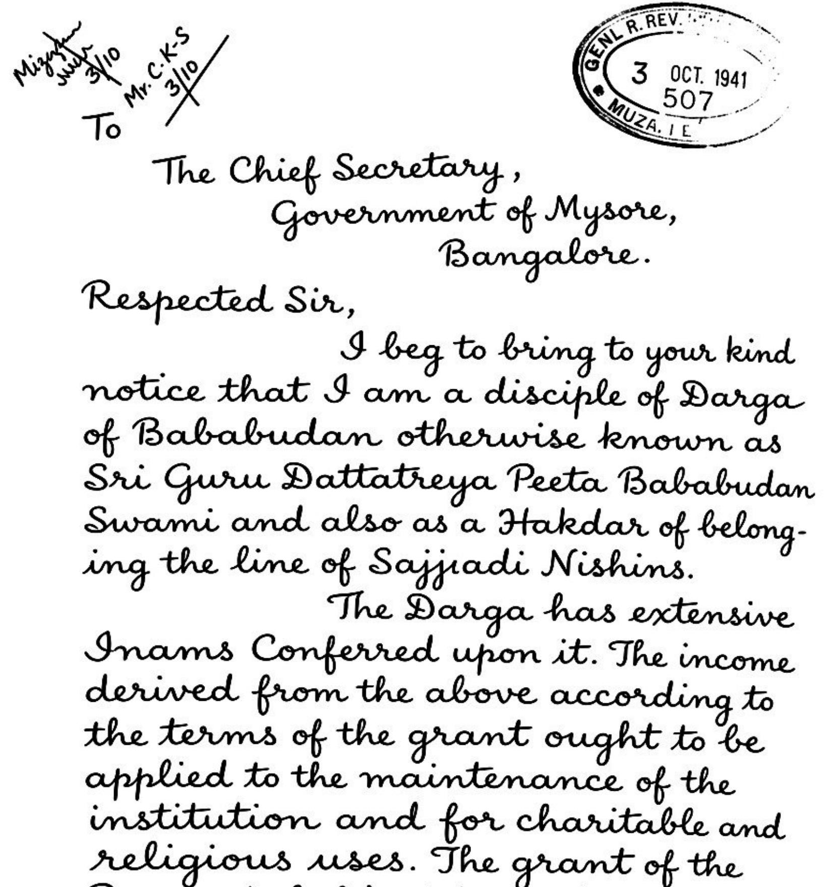
On 27 September 1941, Syed Hazrath Basha of Attigundi submitted a petition to the Chief Secretary, Government of Mysore, raising objections concerning the proposed succession to the Sajjada of the Baba Budan institution.
In his petition, Hazrath Basha described himself as a disciple of the Darga and a Hakdar belonging to what he described as the line of Sajjada Nasheens. He referred to the institution’s Inams and maintained that their income was intended for the maintenance of the institution and for charitable and religious purposes.
The petition also referred to Government Proceedings No. 233–42 dated 14 December 1892 and argued that the opinion of the disciples should be obtained when selecting a successor. Hazrath Basha objected to the proposed nomination of Syed Peer Mohammed, then described in the petition as aged twelve, and raised questions concerning the asserted family relationship involving Gouse Mohiyuddin.
The genealogical statements contained in the petition represent Hazrath Basha’s claims and objections and should not by themselves be treated as establishing the family relationships asserted or disputed in the document. The petition is significant as evidence of the objections placed before the Mysore Government during the succession proceedings that followed.
27 September 1941 · Syed Hazrath Basha · Chief Secretary, Government of Mysore · Received 3 October 1941 · General & Revenue / Muzrai
🟢 DIRECT PETITION · SUCCESSION OBJECTION & GENEALOGICAL CLAIMS
1942–43
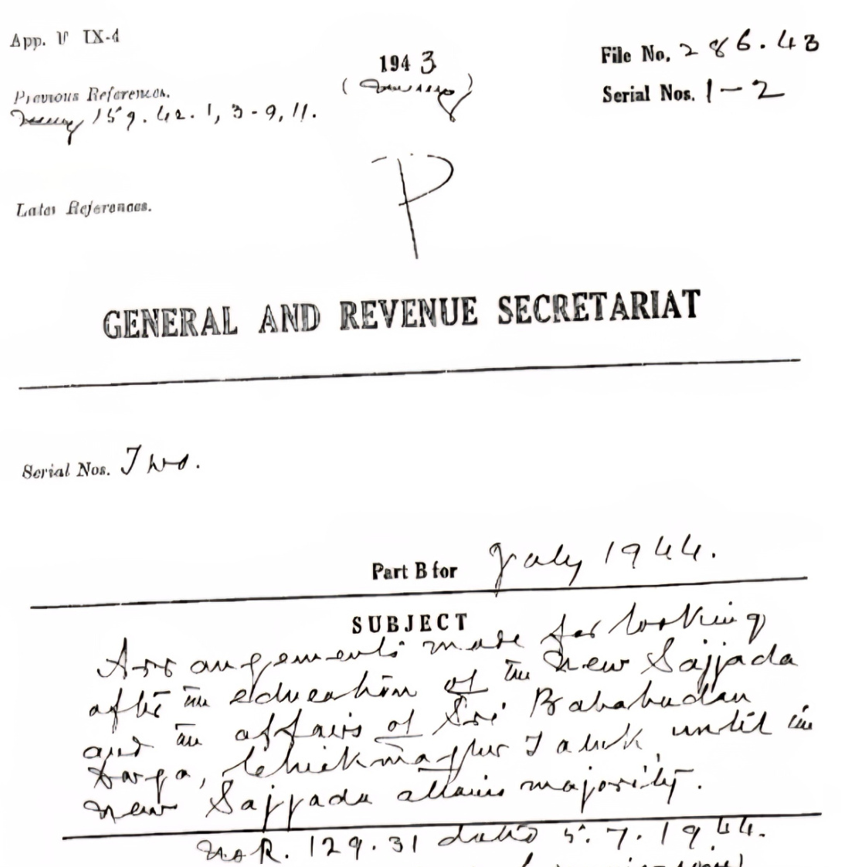
THE SUCCESSION OF PEER MOHAMMED
BD-SAJ-1943-01
Government Recognition of Peer Mohammed as Sajjada
Following the death of Haji Syed Murthuza Badsha Khadri on 21 November 1942, the Mysore Government considered the succession to the office of Sajjada of the Guru Dattatreya Bababudan Darga.
The Government proceedings record the approval of Peer Mohammed as the new Sajjada and state that his installation took place on 12 July 1943, following the necessary induction ceremony.
As Peer Mohammed was then a minor, aged approximately fifteen years, the authorities also considered arrangements for the administration of the institution during his minority. The proceedings provided for supervision involving Ghouse Mohideen ,together with Mrs. Syeda Taj Unnissa, wife of the late Sajjada, until the new Sajjada attained majority, subject to the general control of Government.
The file subsequently continued into 1944 with arrangements concerning Peer Mohammed’s education and the expenditure to be met from the funds of the institution.
21 November 1942–12 July 1943 onward · Government of Mysore · General & Revenue Secretariat · File No. 286-43
🟢 DIRECT GOVERNMENT FILE · SAJJADA SUCCESSION & MINORITY ADMINISTRATION
1955
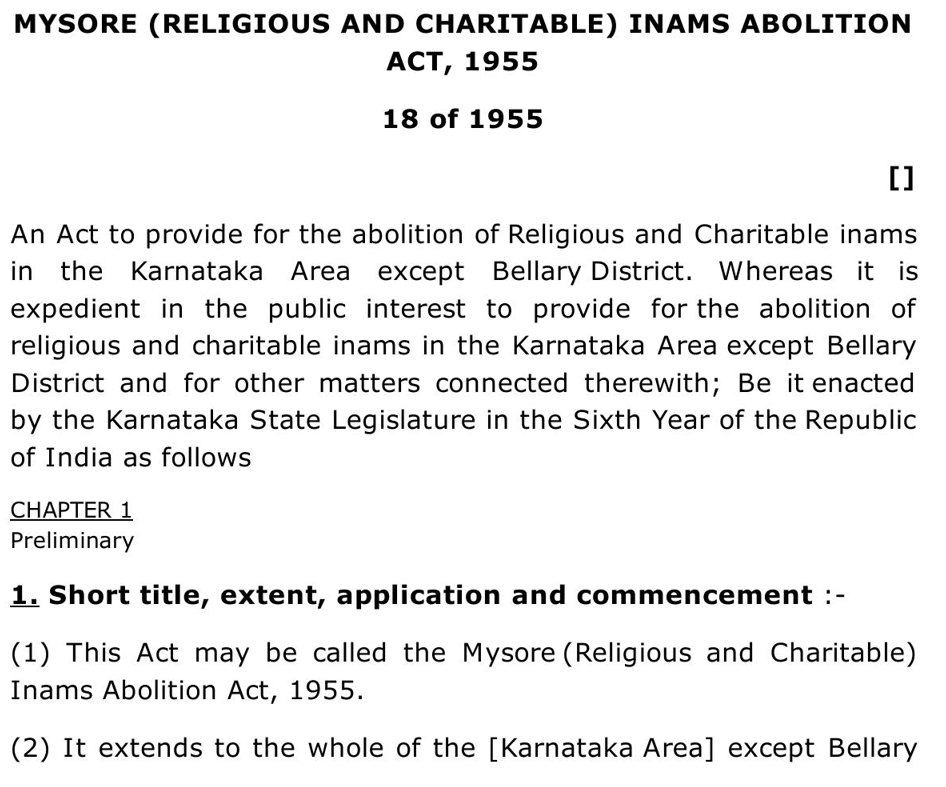
THE ABOLITION OF THE INAMS
BD-INAM-1955-01
The End of the Inam Tenure System
In 1955, the Mysore Legislature enacted the Mysore (Religious and Charitable) Inams Abolition Act, 1955, bringing the historic system of religious and charitable Inams under a new land-revenue framework. The Act applied to religious and charitable Inams and provided for the abolition of the special Inam tenure.
Under the Act, the rights and interests attached to the former Inam tenure vested in the State, while the legislation separately provided mechanisms for recognition of occupancy and other qualifying rights.
Importantly, this should not be understood simply as the Government physically taking possession of every Inam land. The fundamental change was the abolition of the special legal status of the lands as Inam lands and their transition into the ordinary land-revenue system, subject to the occupancy and other rights provided by the Act.
For the Baba Budan / Inam Dattatreya Peetha history, later official and judicial records connect this legislative transition with the former Inam lands and subsequent Tasdik arrangements. However, the original Baba Budan-specific vesting, occupancy and Tasdik proceedings have not yet been recovered in this archive.
1955 · Mysore Legislature · Mysore Act No. XVIII of 1955 · Religious & Charitable Inams Abolition
🟡 OFFICIALLY DOCUMENTED TRANSITION · ORIGINAL BABA BUDAN-SPECIFIC ABOLITION PROCEEDINGS NOT YET RECOVERED
1964
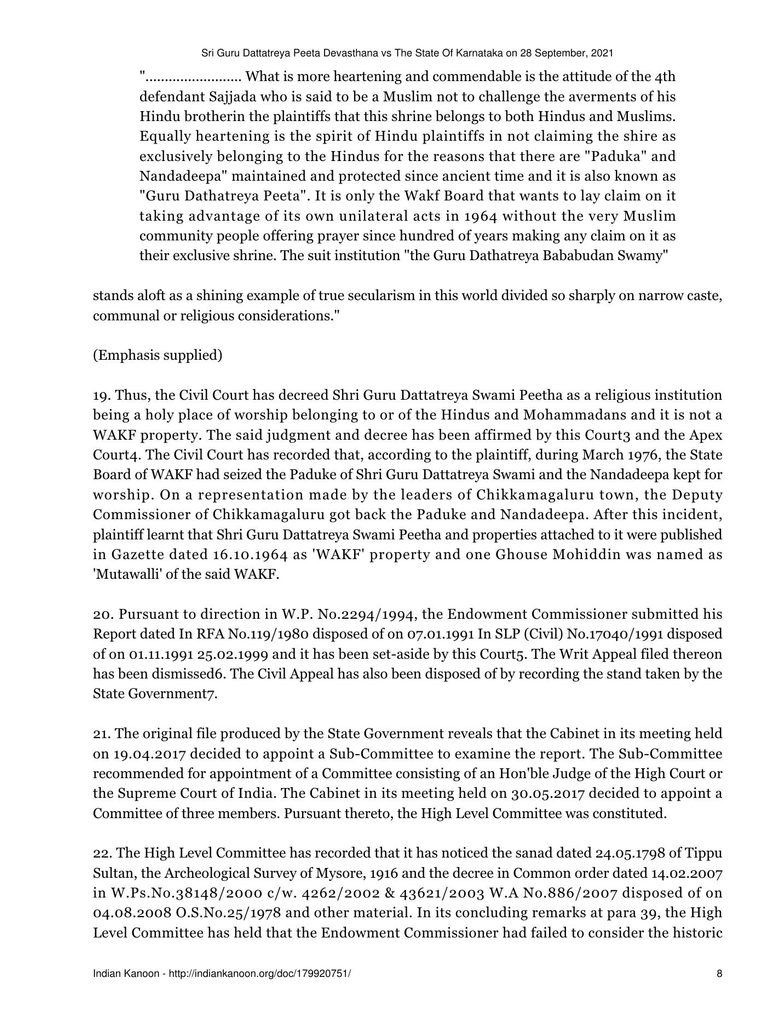
THE WAKF LIST ENTRY
BD-WAKF-1964-01
The Institution Is Included in the List of Wakfs
In October 1964, a major administrative change occurred in the recorded status of the institution. A later Karnataka High Court judgment records that, by an order dated 3 October 1964, the State Government included the religious institution in the list of Wakf institutions. The same judicial record identifies Ghouse Mohiddin as the person named as Mutawalli in the subsequent Gazette entry.
This inclusion later became the subject of litigation. The District Court’s judgment of 29 February 1980, subsequently affirmed by the Karnataka High Court in RFA No.119/1980 on 7 January 1991, held that the religious institution was a holy place of worship associated with both Hindus and Muslims, that it was not Wakf property, and that its inclusion in the Wakf list was improper.
3 October 1964 · State Government Order · Wakf-list inclusion · Gazette publication recorded as 16 October 1964
🟡 LATER JUDICIALLY DOCUMENTED · ORIGINAL 1964 GOVERNMENT ORDER / GAZETTE ENTRY NOT YET RECOVERED
1973
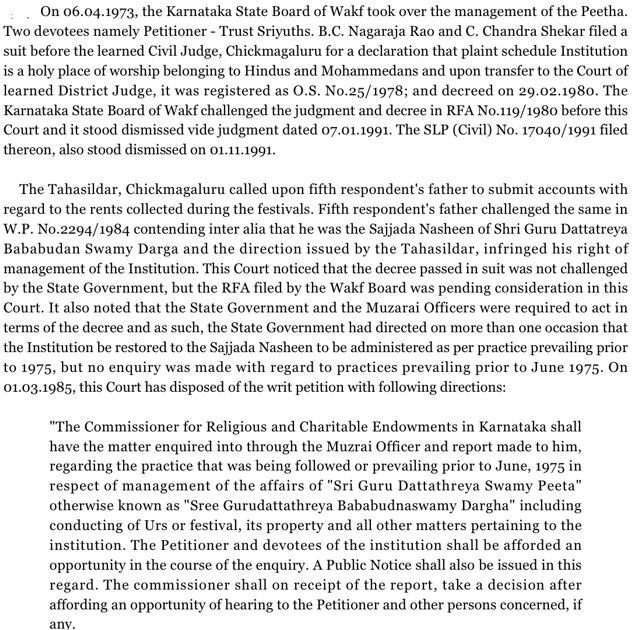
THE WAKF BOARD TAKES OVER MANAGEMENT
BD-WAKF-1973-01
Transfer of Management to the Karnataka State Board of Wakf
On 6 April 1973, the Karnataka State Board of Wakf took over the management of the Baba Budan Dargah. This marked an important administrative change following the institution’s earlier inclusion in the Wakf list.
Later litigation challenged the Wakf Board’s authority over the institution. Those proceedings eventually resulted in the District Court judgment of 29 February 1980 and subsequent appellate proceedings, which are documented separately in this archive.
6 April 1973 · Karnataka State Board of Wakf · Change in institutional management
🟡 LATER JUDICIALLY DOCUMENTED · ORIGINAL 1973 TAKEOVER ORDER / PROCEEDINGS NOT YET RECOVERED
1980
THE DISTRICT COURT JUDGMENT
BD-COURT-1980-01
District Court Decides the Status and Management of the Institution
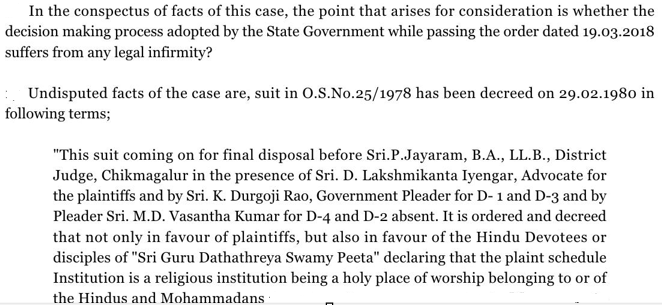
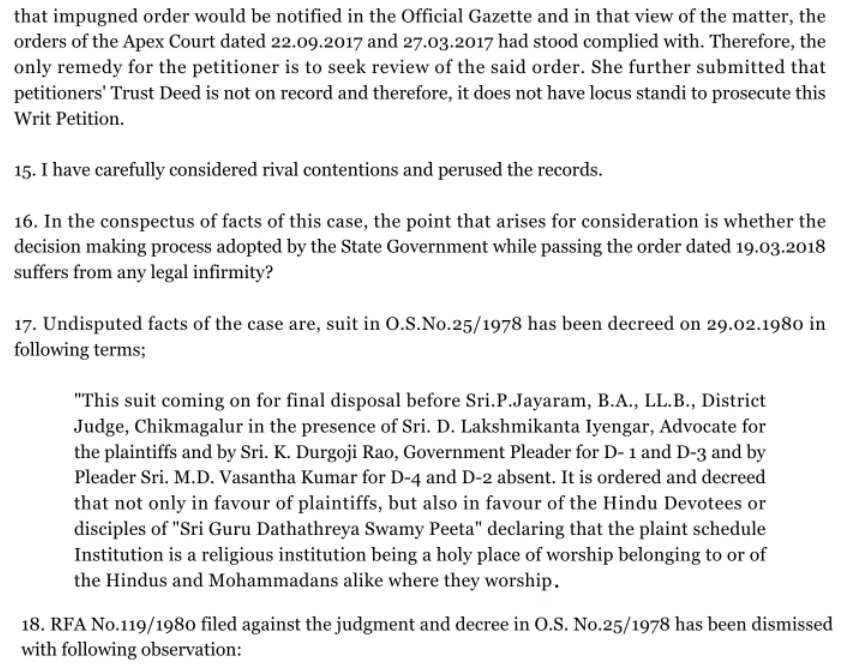
On 29 February 1980, the District Court at Chikmagalur delivered its judgment in O.S. No.25/1978.
The decree declared the institution to be a religious institution and holy place of worship belonging to Hindus and Muslims alike. It held that the institution was not Wakf property, and that its inclusion in the list of Wakfs was improper and illegal.
The Court further directed that the administration, management and control of the institution be transferred from the Wakf Board to the Commissioner for Religious and Charitable Endowments, restoring the administrative position referred to in the decree as that prevailing prior to June 1975.
The Karnataka State Board of Wakf subsequently challenged this decree in R.F.A. No.119/1980 before the Karnataka High Court.
29 February 1980 · District Court, Chikmagalur · O.S. No.25/1978
🟢 JUDICIALLY DOCUMENTED DECREE · OPERATIVE PORTION REPRODUCED IN LATER HIGH COURT JUDGMENTS
1985
THE HIGH COURT ORDERS A FRESH ENQUIRY
BD-COURT-1985-01
High Court Directs Enquiry into the Pre-1975 Administrative Practice
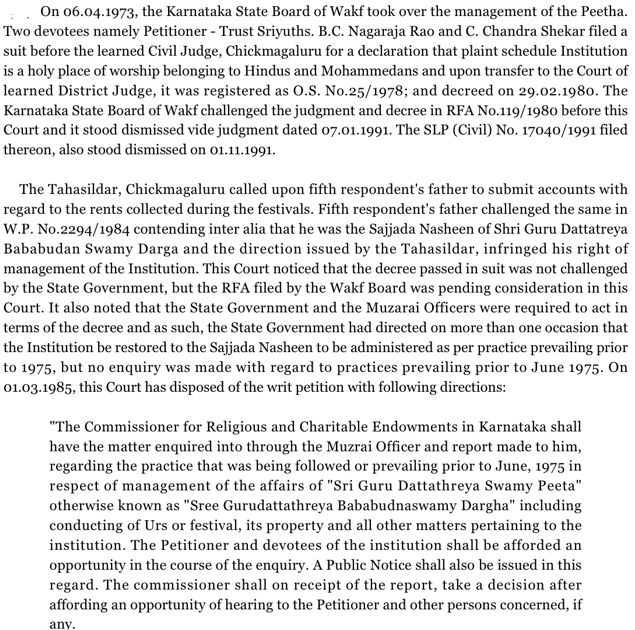
On 1 March 1985, the Karnataka High Court disposed of W.P. No.2294/1984 and directed the Commissioner for Religious and Charitable Endowments to have an enquiry conducted through the Muzrai Officer.
The enquiry was to examine the practices prevailing prior to June 1975 concerning the management and affairs of the institution, including its festivals, property and other related matters.
The Court also required that the petitioner and devotees be given an opportunity to participate, that public notice be issued, and that the Commissioner take a decision after considering the enquiry report and hearing the persons concerned.
This direction became the basis for the subsequent administrative enquiry and the later 1989 Endowment Commissioner proceedings.
1 March 1985 · Karnataka High Court · W.P. No.2294/1984 · Direction for Muzrai enquiry
🟢 JUDICIALLY DOCUMENTED · ENQUIRY INTO PRE-JUNE 1975 ADMINISTRATIVE PRACTICE
1988
THE MUZRAI OFFICER’S ENQUIRY
BD-ADM-1988-01
Report on the Practices Prevailing Prior to June 1975
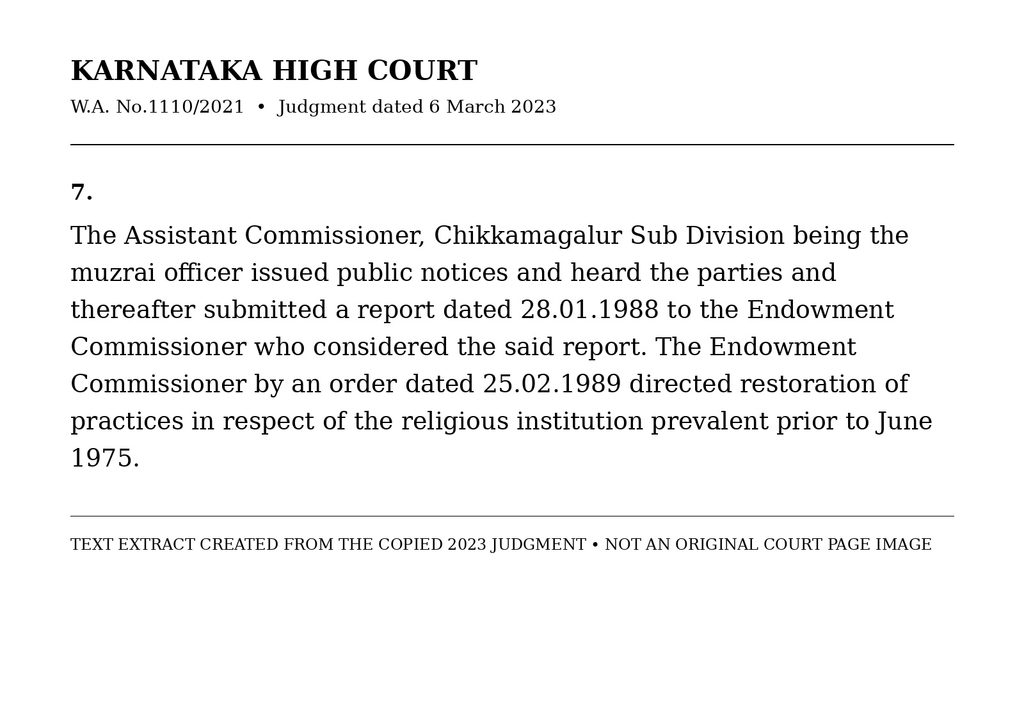
Following the Karnataka High Court’s directions of 1 March 1985, the Assistant Commissioner, Chikkamagaluru Sub-Division, acting as the Muzrai Officer, conducted the enquiry into the practices prevailing at the institution prior to June 1975.
The Muzrai Officer issued public notices, heard the parties and conducted the enquiry, and subsequently submitted his report to the Endowment Commissioner on 28 January 1988.
The Endowment Commissioner considered this report before issuing the subsequent order dated 25 February 1989 concerning the practices prevailing prior to June 1975.
28 January 1988 · Assistant Commissioner, Chikkamagaluru Sub-Division · Muzrai Officer · Report submitted to the Endowment Commissioner
🟡 LATER JUDICIALLY DOCUMENTED · ORIGINAL 1988 MUZRAI OFFICER’S REPORT NOT YET RECOVERED
1989
THE ENDOWMENT COMMISSIONER’S ORDER
BD-ADM-1989-01
Order Concerning the Practices Prevailing Prior to June 1975
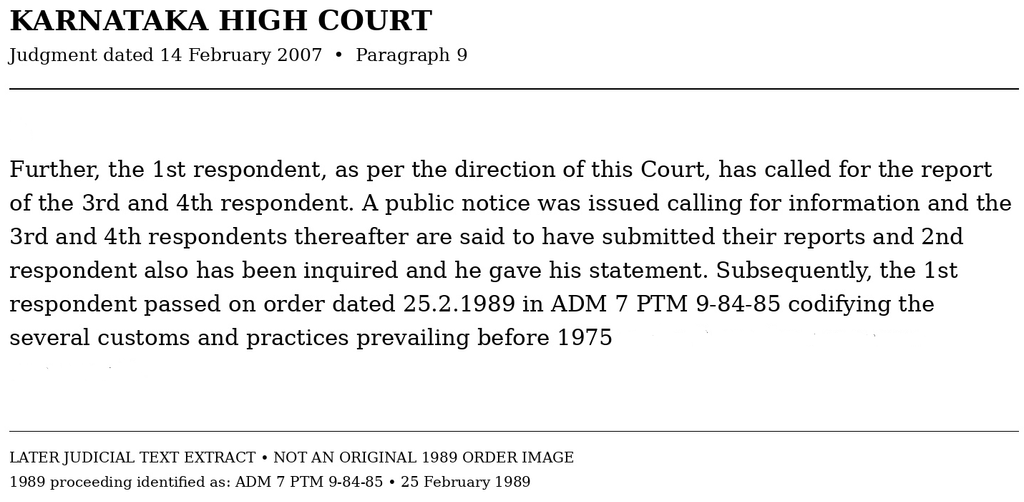
Following the enquiry conducted by the Muzrai Officer, the Endowment Commissioner considered the report dated 28 January 1988 and issued an order on 25 February 1989 concerning the practices prevailing at the institution prior to June 1975.
The 1989 order became an important part of the subsequent administrative and judicial proceedings concerning the institution. Its contents and legal effect were later considered in proceedings before the Karnataka High Court and the Supreme Court.
Importantly, the order should be presented in this archive as an administrative determination made in 1989, rather than as independent proof that every historical practice described in the proceedings existed from antiquity. Later proceedings concerning this order are documented separately in the archive.
25 February 1989 · Endowment Commissioner, Karnataka · Order following the Muzrai enquiry
🟡 LATER JUDICIALLY DOCUMENTED · ORIGINAL 1989 ENDOWMENT COMMISSIONER ORDER NOT YET RECOVERED
1991
THE HIGH COURT APPEAL
BD-COURT-1991-01
High Court Dismisses the Wakf Board’s Appeal
The Karnataka State Board of Wakf challenged the District Court’s 1980 judgment by filing R.F.A. No.119/1980 before the Karnataka High Court.
On 7 January 1991, the High Court dismissed the appeal, thereby leaving the District Court’s decree undisturbed. Later Karnataka High Court judgments expressly record that the 1980 decree was upheld in R.F.A. No.119/1980.
The litigation then proceeded to the Supreme Court through S.L.P. (Civil) No.17040/1991, which was dismissed on 1 November 1991. Later judicial records consequently describe the earlier decree as having attained finality.
7 January 1991 · Karnataka High Court · R.F.A. No.119/1980 · Appeal against O.S. No.25/1978
🟡 LATER JUDICIALLY DOCUMENTED · ORIGINAL 1991 R.F.A. JUDGMENT NOT YET RECOVERED
2007
THE HIGH COURT REMAND
BD-COURT-2007-01
High Court Orders Fresh Consideration of the 1989 Proceedings
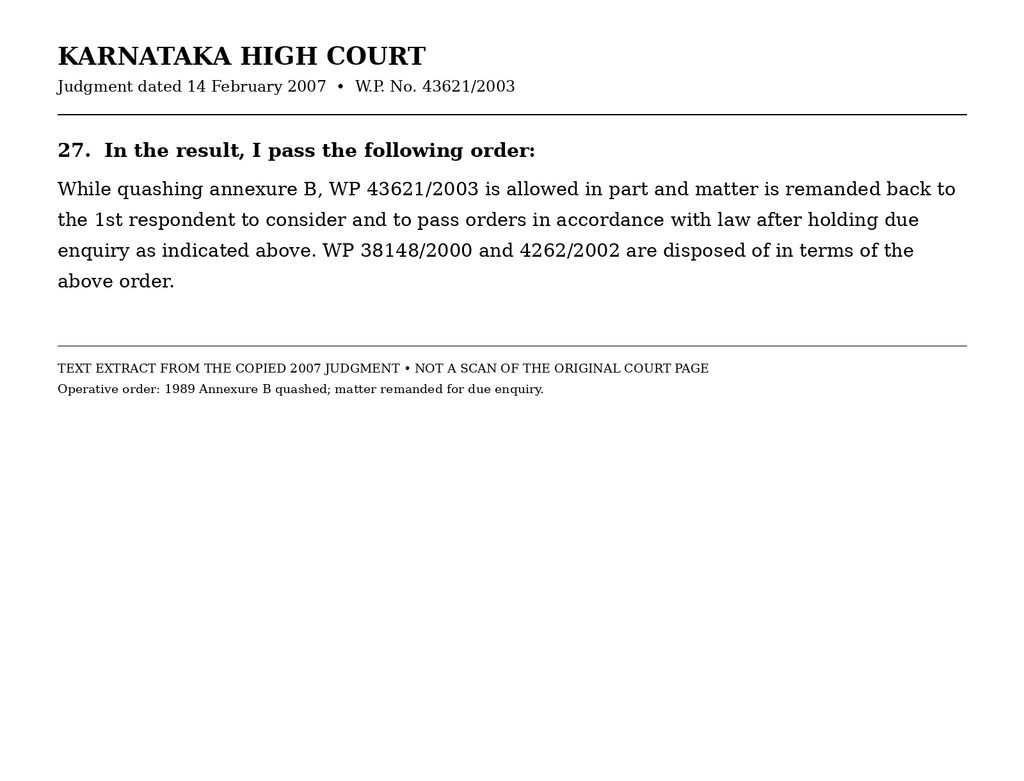
On 14 February 2007, the Karnataka High Court decided connected writ petitions concerning the administration and religious practices of the institution.
In W.P. No.43621/2003, the Court quashed the 25 February 1989 order and remanded the matter to the Commissioner for fresh consideration after taking into account the relevant enquiry material and hearing the concerned parties.
14 February 2007 · Karnataka High Court · W.P. Nos.38148/2000, 4262/2002 & 43621/2003 · Justice H.V.G. Ramesh
🟢 DIRECT JUDICIAL RECORD · 1989 ORDER QUASHED & MATTER REMANDED
2010–2015
THE ENDOWMENT ENQUIRY & SUPREME COURT PROCEEDINGS
BD-END-2010/15-01
Endowment Commissioner Reports to the Supreme Court
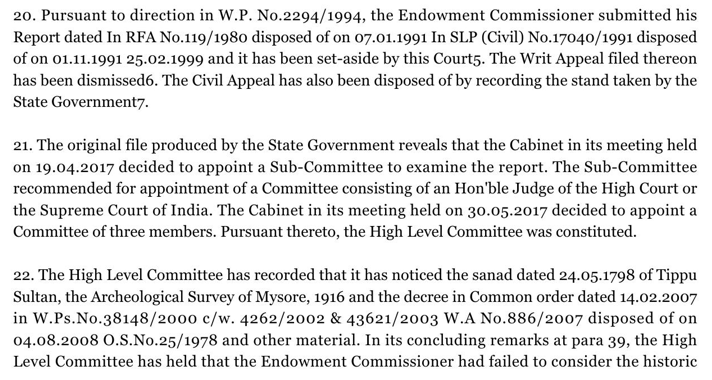
Following the earlier court proceedings, the Endowment Commissioner submitted a report dated 10 March 2010 to the Supreme Court concerning the institution and its religious practices. Objections to the report were subsequently raised by parties before the Court.
On 3 September 2015, the Supreme Court disposed of the connected civil appeals and left the State Government to take a decision on the Commissioner’s report after considering the objections raised by the parties. The Court also directed that the existing interim status quo continue until the State Government made that decision.
10 March 2010–3 September 2015 · Endowment Commissioner · Supreme Court of India · Civil Appeal Nos.2685 & 2686 of 2010
🟢 JUDICIALLY DOCUMENTED · COMMISSIONER’S REPORT & SUPREME COURT DIRECTIONS
2021
THE HIGH COURT JUDGMENT
BD-COURT-2021-01
High Court Quashes the 2018 Government Order
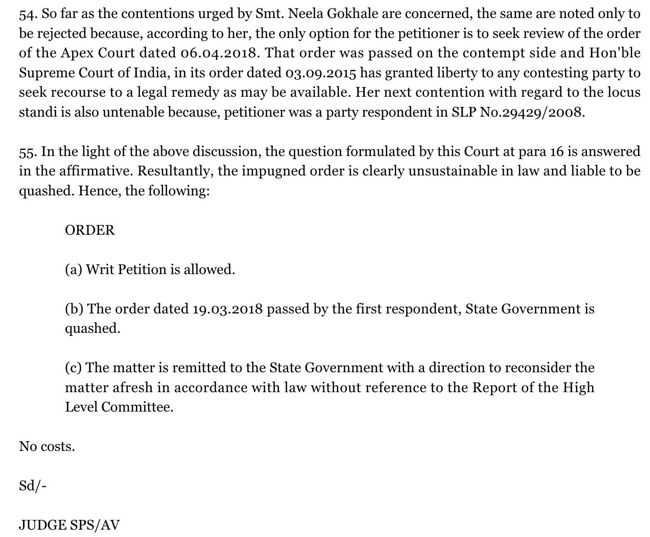
On 28 September 2021, the Karnataka High Court decided W.P. No.18752/2018, which challenged the State Government order dated 19 March 2018.
After examining the earlier judicial proceedings, the Endowment Commissioner’s report and the subsequent decision-making process, the Court held that the impugned Government order was unsustainable in law and liable to be quashed.
The matter was remitted to the State Government for fresh consideration in accordance with the Court’s directions.
28 September 2021 · Karnataka High Court · W.P. No.18752/2018 · Justice P.S. Dinesh Kumar
🟢 DIRECT JUDICIAL RECORD · 2018 GOVERNMENT ORDER QUASHED & MATTER REMITTED
2023
THE DIVISION BENCH JUDGMENT
BD-COURT-2023-01
High Court Dismisses the Appeal Against the 2021 Judgment
On 6 March 2023, a Division Bench of the Karnataka High Court decided W.A. No.1110/2021, arising from the Single Judge’s judgment of 28 September 2021.
After considering the earlier judicial and administrative history, the Division Bench dismissed the appeal, leaving the result of the 2021 judgment undisturbed.
6 March 2023 · Karnataka High Court, Division Bench · W.A. No.1110/2021 · Justice Alok Aradhe & Justice Vijaykumar A. Patil
🟢 DIRECT JUDICIAL RECORD · DIVISION BENCH APPEAL DISMISSED