1902 — Government Recognition of Syed Murthuza Basha Khadri as Sajjada
Guru Dattatreya Bababudanswami’s Darga · Government of Mysore · 24 November 1902
ARCHIVE ID: BD-SAJ-1902-01Historical significance
This government proceeding records the official recognition of Syed Murthuza Basha Khadri, son of Syed Mohamed Shah Khadri, as Sajjada or Manager of the institution following the death of Khan Bahadur Syed Ghouse Shah Khadri on 17 September 1901. The decision followed representations and objections concerning succession, customary selection, management and participation in the institution’s Inam income.
What the 1902 proceedings record
1. Earlier appointment and death
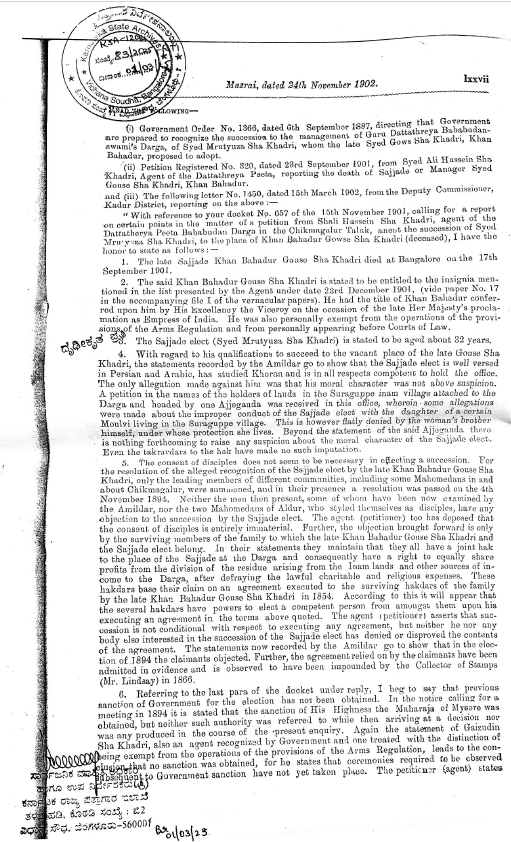
The record refers to Government Order No. 1366 dated 4 September 1887, concerning recognition of management of the Darga, and states that Syed Ghouse Shah Khadri died on 17 September 1901. It reports that he had previously adopted Syed Murthuza Basha Khadri to succeed him.
2. Succession dispute and customary claims
The preceding discussion, printed on page lxxvii of the proceedings, considers objections and statements made by interested parties. It refers to claims that the Hakdars traditionally selected a Sajjada and that an agreement had been executed in 1854. These are matters recorded and assessed in the government proceeding; the existence and legal effect of any separate 1854 instrument should be assessed against its original text.
3. Government’s decision on the office
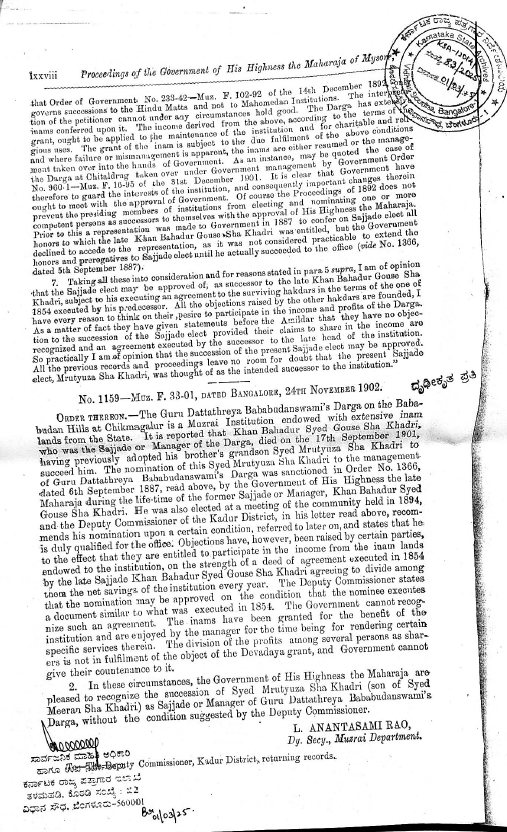
On page lxxviii, the government concludes that Syed Murthuza Basha Khadri may be recognized as Sajjada or Manager. The final order specifically states that the recognition is without the condition suggested by the Deputy Commissioner.
4. Inam income distinguished from management
The proceeding states that the Darga was a Muzrai institution endowed with extensive Inam lands and that income was enjoyed by the manager for the institution’s benefit. It rejects treating management as a basis for an individual right to share the Inam income. Thus, recognition of the office and claims to the income must not be conflated.
Documentary extracts
The following short passages reproduce the substance of the printed order. Spelling and capitalization follow the historical source where practical.
“The Government cannot recognise such an agreement.”
The passage concerns a purported agreement affecting distribution of income, discussed in the 1902 order.
“The Government of His Highness the Maharaja are pleased to recognise the succession of Syed Murthuza Basha Khadri … as Sajjada or Manager … without the condition suggested by the Deputy Commissioner.”
The complete wording should be consulted in the scan below, particularly paragraph 2 of Order No. 1159.
Original facsimile scans
Upload only the first two pages of the supplied six-page PDF to your WordPress Media Library as separate images. Replace the two marked image URLs below with their public Media Library URLs. The later 1941 and 1943 pages in the supplied PDF are separate historical records and are not facsimiles of this 1902 order.
Relationship to the 1901–02 succession petition
The separate archival entry BD-PET-1901/02-01 preserves the petition by Syed Jamal Shah Khadri and Syed Khader Basha Khadri, including its genealogical enclosure and objections concerning the Makan and the proposed agent, Syed Shahali Hussaini. The present entry documents the subsequent government proceeding. The petitioners’ allegations and the government’s final decision should be read as distinct historical evidence.
Editorial and source notes
Source boundaries: The supplied six-page PDF combines multiple historical records. Only pages 1 and 2 are the relevant 1902 proceedings. Page 3 is a 1943 routine proceedings extract; pages 4–6 belong to a 1941 administration report. They are intentionally excluded from this entry.
Names and terminology: The order uses “Sajjada or Manager” and “Darga”; these period forms are retained when discussing the document. The related petition’s term Makan is not silently replaced with “Makam.”
Scope: This 1902 administrative recognition does not, by itself, establish present-day ownership of land, current management rights or the final outcome of later disputes.