Baba Budan Archives · Documentary chronology · BD-WAKF-1964-01
1964 — The Wakf List Entry
Administrative inclusion, contested legal status, and the documentary questions that remain
Historical background
Judicial records describe the institution on the Baba Budan Hills, referred to in different records as Guru Dattatreya Peetha, Baba Budan Dargah and related forms, as having been associated with the Mysore Muzrai administration. The Karnataka High Court’s judgment in Karnataka Board of Wakfs v. B. C. Nagaraja Rao (7 January 1991) recounts its subsequent inclusion in the list of Wakfs.
What happened in 1964?
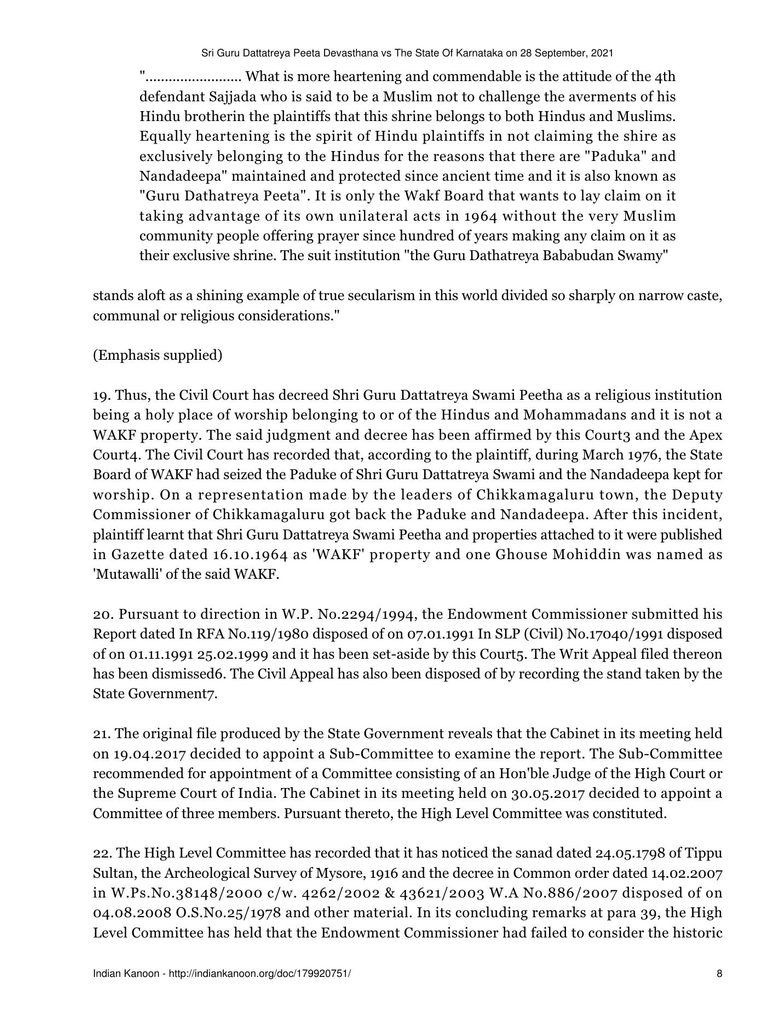
A later Karnataka High Court Division Bench judgment, dated 6 March 2023, states that a State Government order dated 3 October 1964 included the religious institution in the list of Wakf institutions. A separate High Court judgment of 28 September 2021 describes a 16 October 1964 Gazette reference in its account of the earlier litigation. Another judicial account refers to 19 October 1964. These dates are reported here as they appear in later sources; their exact relationship cannot be settled without the original notification and Gazette.
| Date appearing in later record | How it is described | Editorial treatment |
|---|---|---|
| 3 October 1964 | State Government order, as described in the 2023 Division Bench judgment | Judicially reported order date, not yet verified against original order |
| 16 October 1964 | Gazette date mentioned in the 2021 High Court judgment | Judicially reported publication reference |
| 19 October 1964 | Notification date referred to in another later judicial account | Unreconciled date; original required |
What did the entry establish?
The inclusion was an administrative listing whose legal validity and consequences were later challenged. It should not be presented as independent proof of ownership of every parcel of land historically connected with the institution, nor as proof that management or physical possession changed on the date of publication. Any parcel-level claim requires the actual Gazette schedule and corresponding land records.
Subsequent litigation and judicial outcome
The inclusion and management of the institution became subjects of civil litigation. A civil court decree dated 29 February 1980 was examined on appeal in Karnataka Board of Wakfs, Bangalore v. B. C. Nagaraja Rao and Others, RFA No. 119/1980. On 7 January 1991, the Karnataka High Court dismissed the Wakf Board’s appeal. The judgment addresses the nature of the institution, the parties’ claims, the administrative history and the legality of the Wakf-list inclusion. The court’s actual reasoning and operative result—not an isolated response to a framed issue—must guide interpretation.
Later judgments, including those delivered in 2021 and 2023, recount this litigation. Their descriptions of 1964 are valuable historical leads, but are not substitutes for the original Gazette.
Archival exhibit: a later reference, not the original Gazette
Primary records still required
The archive seeks the complete 1964 Government order, the Gazette issue and pages, the Wakf list entry and property schedule, any underlying survey or enquiry report, and contemporary correspondence on management and possession. Until these are obtained, exact land descriptions, notification numbers and the precise sequence of publication must remain open questions.
Judicial sources and further reading
- Karnataka High Court, W.A. No. 1110/2021, judgment dated 6 March 2023 (official judiciary PDF) — references the order dated 3 October 1964.
- Sri Guru Dattatreya Peeta Devasthana v. State of Karnataka, 28 September 2021 — records the 16 October 1964 Gazette reference.
- Karnataka Board of Wakfs v. B. C. Nagaraja Rao, 7 January 1991 — appellate judgment on the earlier civil dispute.
- Later judicial account referring to 19 October 1964 — included to preserve the unresolved date discrepancy.