Anegondi Era
The Earlier Inam Tradition
An earlier history of the institution’s Inam lands, preserved in a nineteenth-century Mysore settlement record.
Earlier event: referenced in later record1873 settlement: surviving archival source01 · What the 1873 Record Says
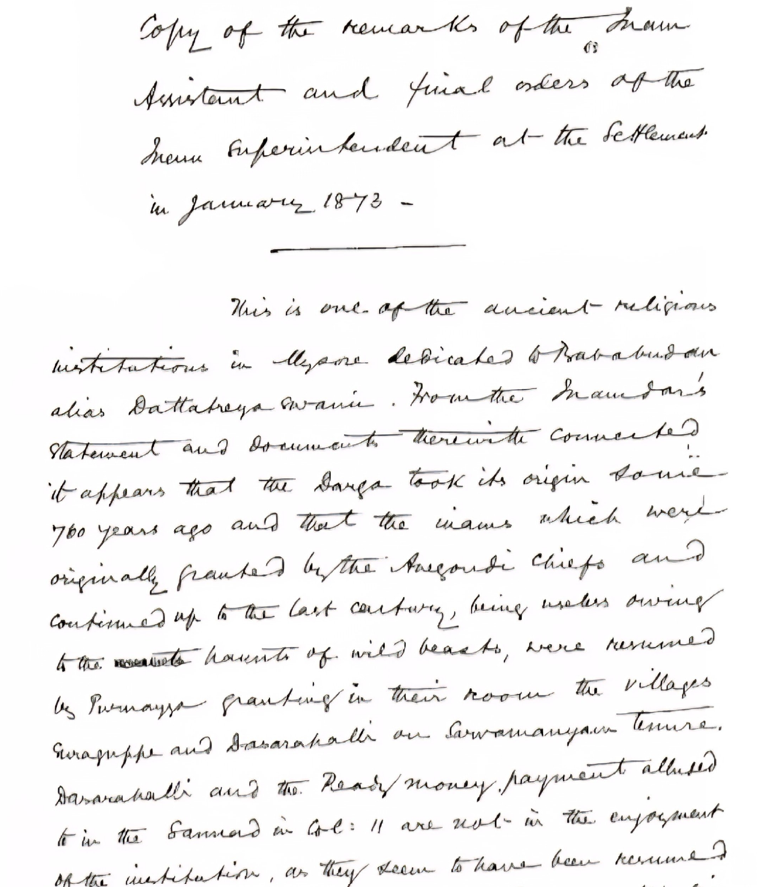
The surviving evidence for this earlier Inam tradition comes from the Mysore Inam Settlement proceedings of January 1873. The settlement authorities recorded a historical account based on the Inamdar’s statement and connected documents then before them. That account attributed the institution’s original Inams to the chiefs of Anegondi.
The importance of the passage is its documentary context: by 1873, this attribution formed part of an official settlement record. It does not, on its own, authenticate the precise date or terms of an original Anegondi-period grant.
02 · The Chain of Evidence
Earlier period — Anegondi chiefs. An original Inam grant is attributed to the chiefs in the historical account later recorded by Mysore officials. Its original instrument is not presently held.
Early nineteenth century — Purnaiyya. The same later record recounts resumption of earlier Inams and substitution of villages associated with Suraguppa and Dasarahalli, described in the settlement material as Sarwamanyam tenure. This is a separate phase of the account, not a surviving Purnaiyya order.
9 January 1873 — Mysore Inam Settlement. The authorities’ remarks and final settlement orders preserve the earlier narrative, including the basis given for it: the Inamdar’s statement and connected documents.
03 · What We Can—and Cannot—Conclude
Supported by the surviving record
The 1873 settlement account expressly attributes the original Inams to the Anegondi chiefs.
It also describes later Purnaiyya-era changes and identifies Suraguppa and Dasarahalli in the account of substituted villages.
Still awaiting primary evidence
The original Anegondi sanad or grant, its exact date, boundaries and conditions have not been independently verified from that original instrument.
The original Purnaiyya administrative order and the underlying Inamdar statement, connected enclosures and referenced sanad remain important research targets.
04 · Principal Archival Source
BD-INAM-1873-01 — Mysore Inam Settlement, January 1873. The relevant pages are described in our archival copy as the remarks of the Inam Assistant and final orders of the Inam Superintendent. The significant historical passage appears on PDF page 33, with continuation on page 34.
Readers should examine the genuine scanned settlement pages in the dedicated 1873 Inam Settlement archive entry, rather than treating this explanatory page or its illustration as a primary document.
Source classification: 1873 official record — directly reproduced in the archive; Anegondi-period grant — referenced in the 1873 account, original not presently held.